





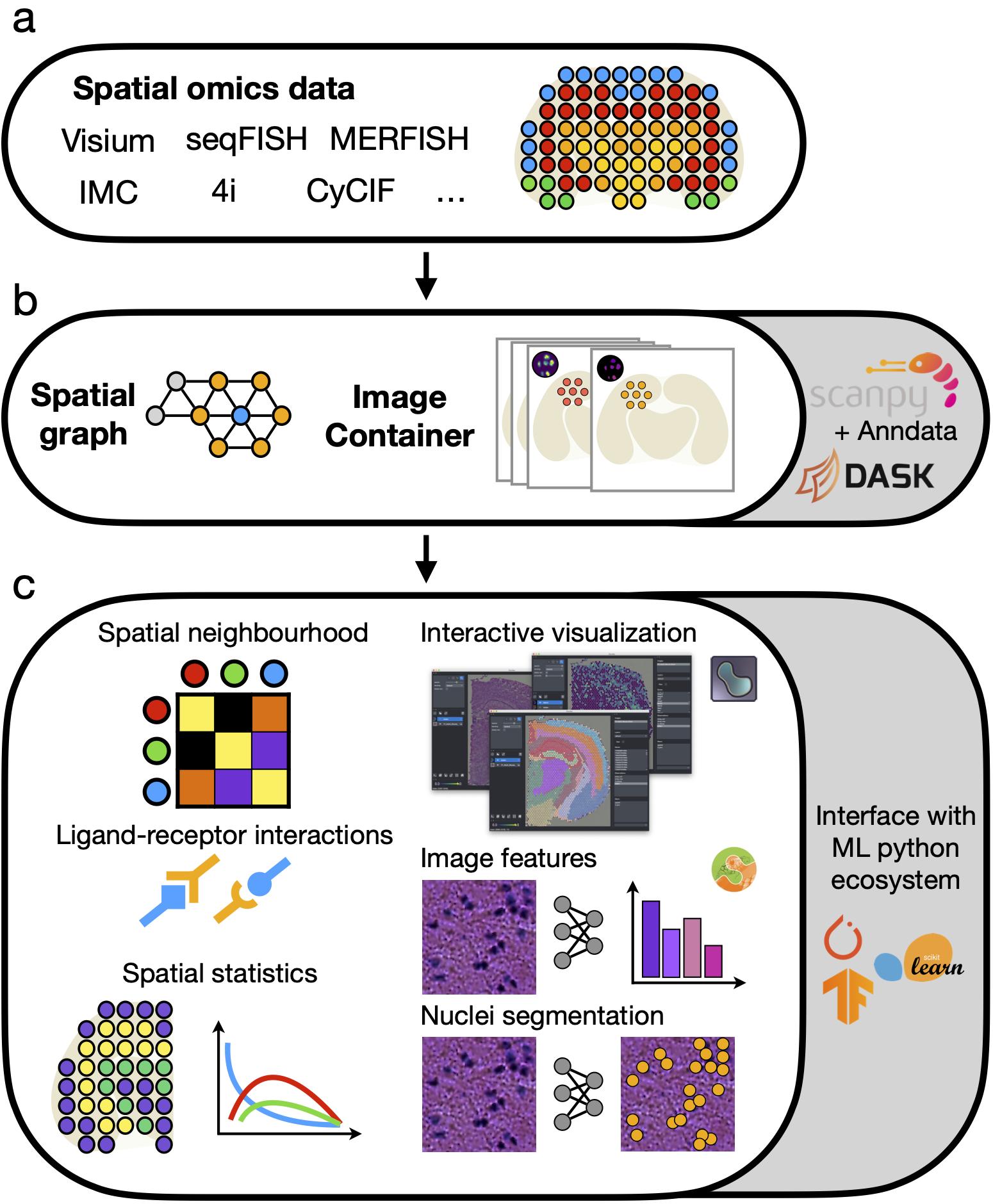
Squidpy is a tool for the analysis and visualization of spatial molecular data. It builds on top of scanpy and anndata, from which it inherits modularity and scalability. It provides analysis tools that leverage the spatial coordinates of the data, as well as tissue images if available.
🚨🚨🚨 **Warning!** 🚨🚨🚨

The original napari-plugin of Squidpy has been moved to [napari-spatialdata].

All the functionalities previously available are also implemented in the new plugin, which also has many additional new features.

You can find a rich set of [documentation and examples], and we suggest starting with the [napari-spatialdata tutorial].

If you are new to SpatialData, we invite you to take a look at the [spatialdata tutorials].
Squidpy is part of the scverse® project (website, governance) and is fiscally sponsored by NumFOCUS. Please consider making a tax-deductible donation to help the project pay for developer time, professional services, travel, workshops, and a variety of other needs.

Please see our manuscript Palla, Spitzer et al. (2022) in Nature Methods to learn more.
- Build and analyze the neighborhood graph from spatial coordinates
- Compute spatial statistics for cell-types and genes
- Efficiently store, analyze and visualize large tissue images, leveraging scikit-image
- Interactively explore spatial data with napari-spatialdata
We are happy about any contributions! Before you start, check out our contributing guide.
.. toctree::
    :caption: General
    :maxdepth: 2
    :hidden:

    installation
    api
    classes
    extensibility
    release_notes
    references
    contributing

.. toctree::
    :caption: Gallery
    :maxdepth: 2
    :hidden:

    notebooks/tutorials/index
    notebooks/examples/index
    notebooks/deprecated_features/index