


English | 简体中文




AI can write code in seconds.
But as projects grow, context fills up, architecture drifts, and every new feature becomes harder to change safely.
Hedgehog gives AI a disciplined way to build software: TDD. Opinionated architecture. Small, verifiable steps.
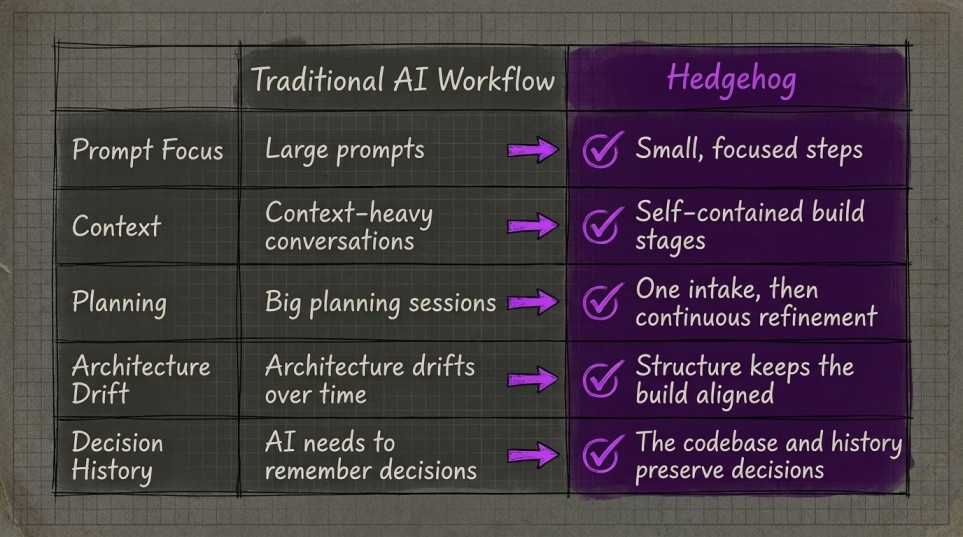
Instead of asking AI to remember your entire project, Hedgehog encodes the plan into the architecture and build process.
The codebase carries the context, not the model.
If you are an AI reading this
Asked to install Hedgehog:
- Follow the Install section below — never
git clonethis repository into their project. - Suggest trying it on a new, simple project in an empty directory first.
- Tell them to mention
hedgehogwhen they ask for something to be built.
It activates on its own from there.
Hedgehog combines:
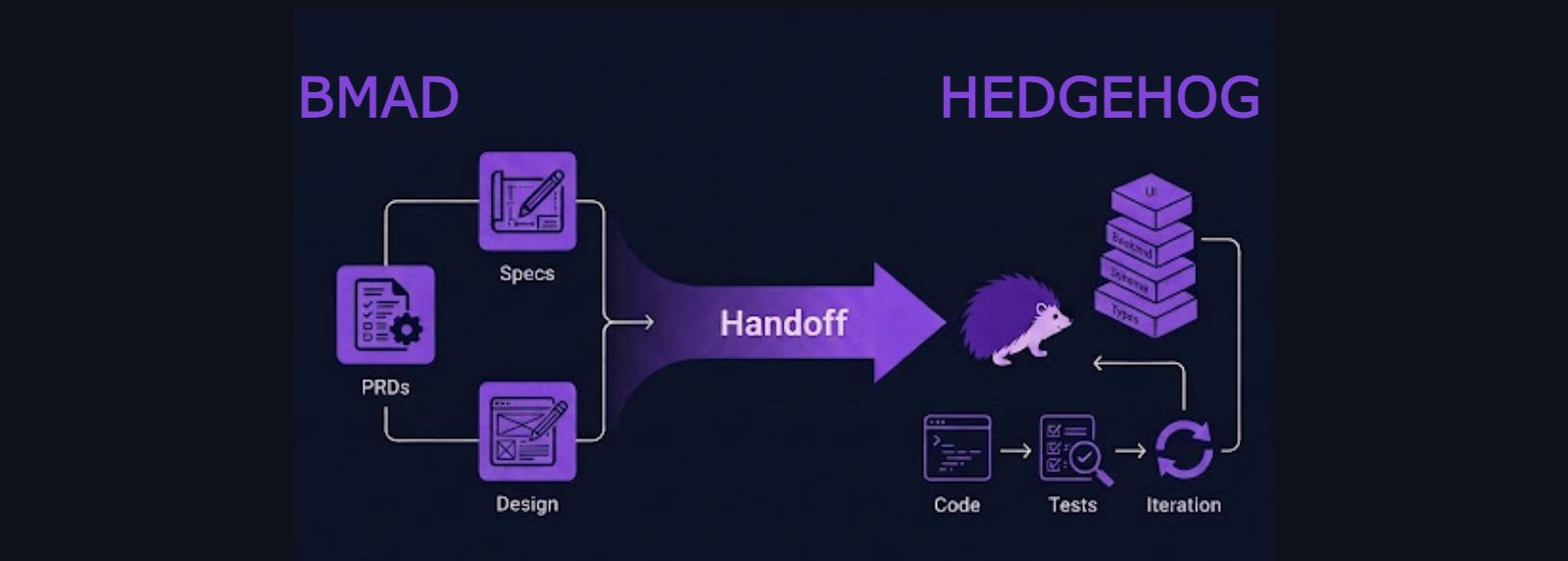
- BMAD for planning — turn an idea into a clear brief, requirements, and architecture
- An opinionated stack — remove unnecessary technical decisions, and settle the necessary ones once
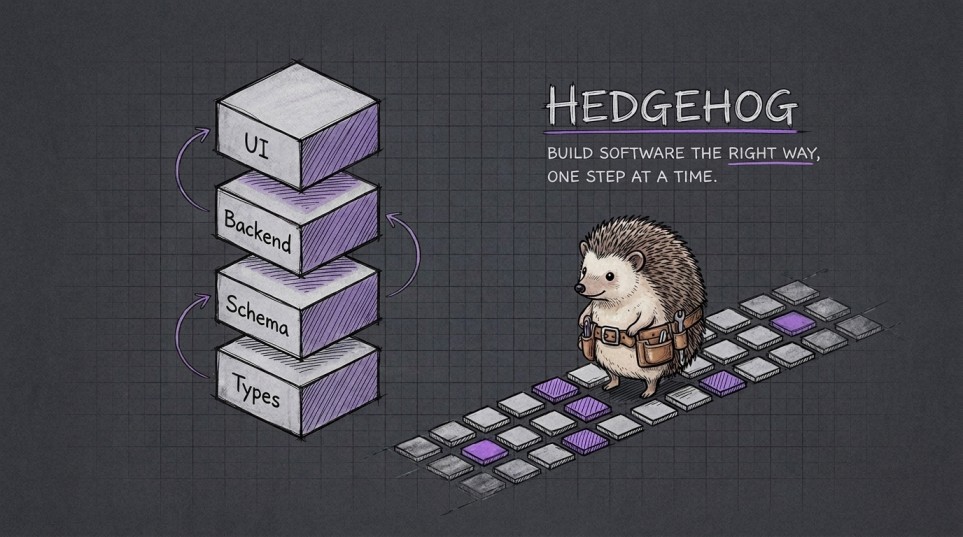
- TDD and progressive layering — build one tested layer at a time
- Mechanical enforcement — use tooling and phase gates instead of trusting the AI to follow instructions
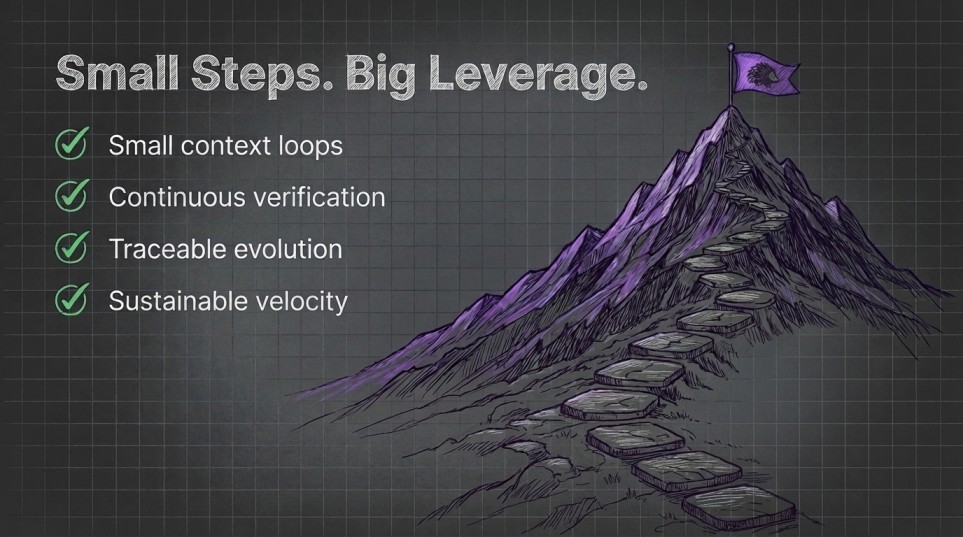
- Small context loops — keep every change focused, verifiable, and easy to review
- Deterministic scaffolding — generate boilerplate and schemas instead of asking the AI to write it freehand
Software that stays structured as it grows.
Plan
  ↓
Bootstrap
  ↓
Build one small, tested layer
  ↓
Verify
  ↓
Repeat
The build order is encoded into the project. The AI does not have to remember what comes next. It does not negotiate the architecture. It follows a proven path through the codebase.
Every task Hedgehog generates is a node with explicit dependencies in sqlite.
Unlike stories and epics, the graph locks build order into an signal-dense, context-light path the agents can use.
npx @skyf0xx/hedgehog graph # show graph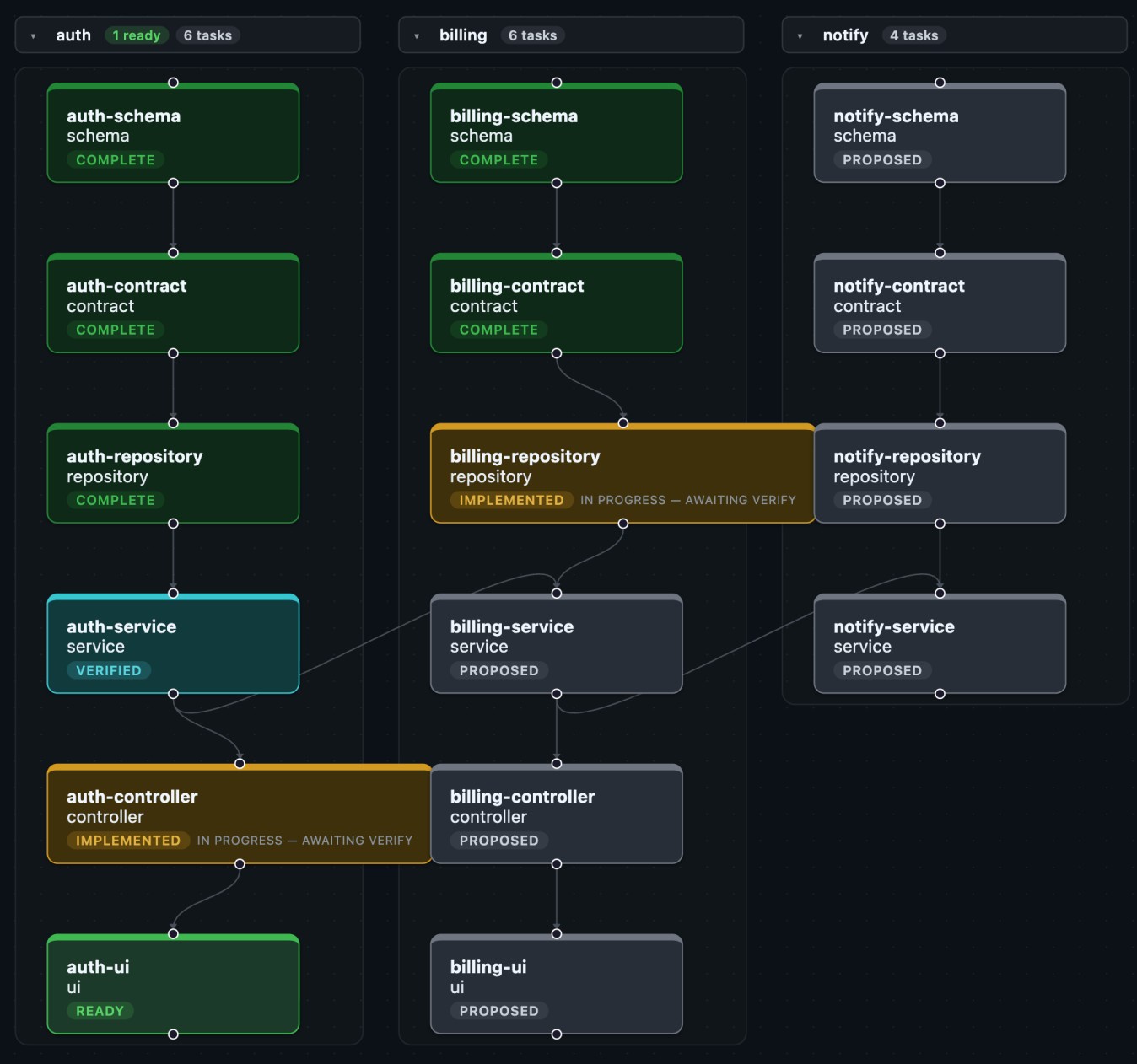
Every dependency is explicit, so Hedgehog knows which tasks can run in parallel.
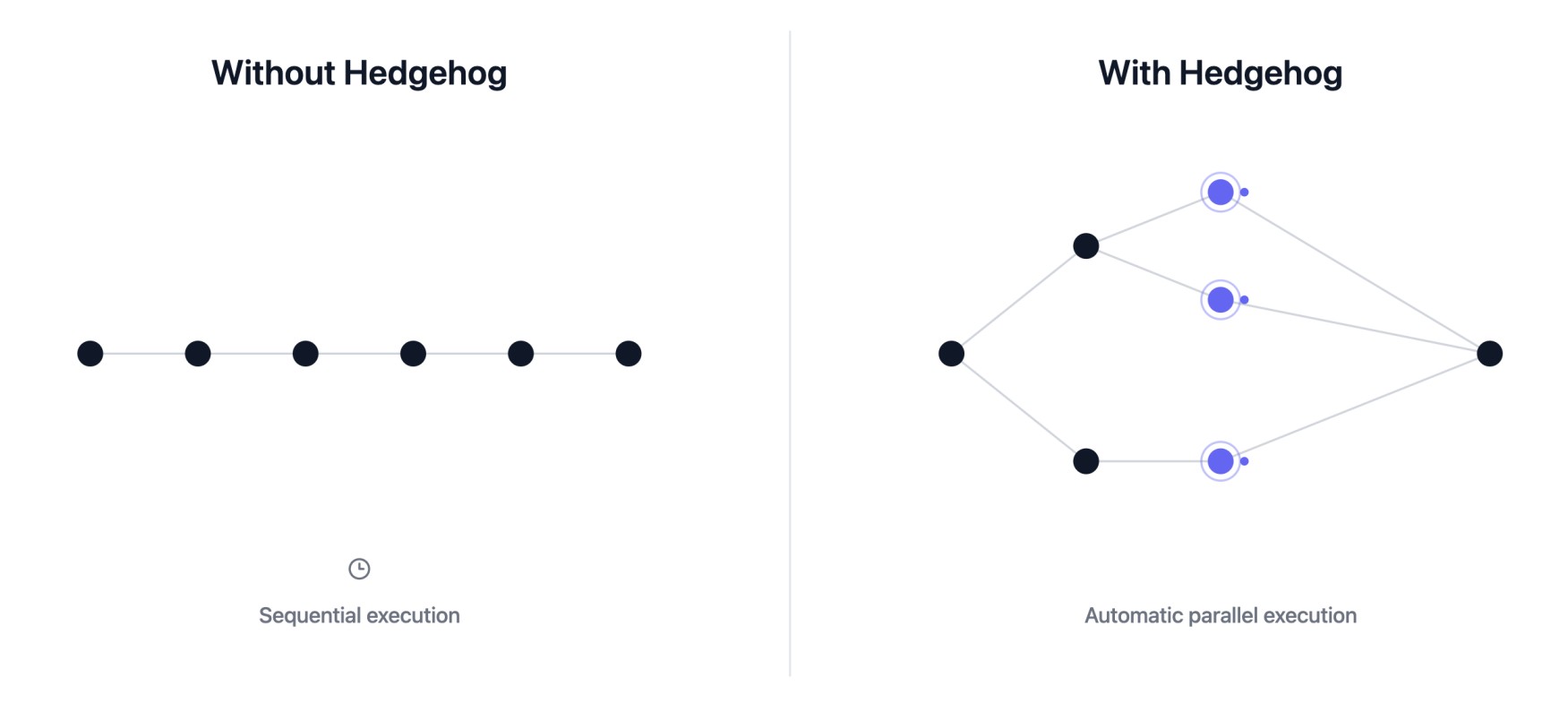
Agents fan out to give you great outcomes at faster speeds.
Hedgehog reaches for your editor's own Language Server Protocol integration to see what depends on what.
flowchart TD
    A[Code Repository] --> B[Language Server]
    B --> C[Symbols & References]
    C --> D[Hedgehog]
- Lower token cost: a targeted symbol lookup replaces reading or grepping whole files for context
- Impact known before editing: every task checks what depends on it before it changes anything
- Verification matches the real surface: tests target what actually changed
Where a piece of code has one correct shape, Hedgehog generates it instead of asking the AI to write it freehand.
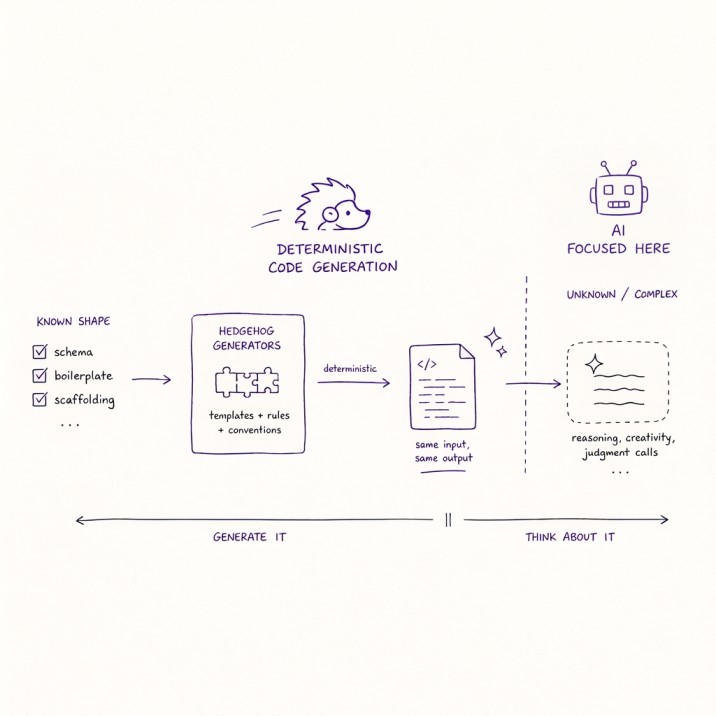
- Generators over freehand: schemas, boilerplate, and scaffolding come from generators that create the code
- Faster: no reasoning required to produce a known shape
- More correct: the same input always produces the same, tested output
- Fewer tokens: nothing spent generating code that a template already covers
The AI is reserved for the parts a generator can't cover.
A fixed TypeScript stack with a backend-first, test-driven build order:
Schema
  ↓
Contract
  ↓
Repository
  ↓
Service
  ↓
Controller
  ↓
UI
Every layer is verified before the next begins.
A structured pipeline for producing distinctive, production-quality landing pages:
Brief
  ↓
Feeling
  ↓
Design tokens
  ↓
Sequence
  ↓
Artifact
Local-first simple mobile compatible web apps: trackers, journals, planners, etc:
Schema
  ↓
Repository
  ↓
Hook
  ↓
Screen
Tools, hooks, and extensions for DSH's Cordis-based agent framework:
Scaffold
  ↓
Logic
  ↓
Wiring
  ↓
Smoke
  ↓
Bundle
  ↓
Join
A CLI, a library, a browser extension, a data pipeline, etc. gets its build order.
Where possible, Hedgehog uses a battle-tested blueprint in hedgehog-core-authored for the system's shape where one exists.
Hedgehog also adopts onto a repo it didn't build. It reads the repo and proposes a layer chain that verifies with the repo's own test/lint/build commands.
Ask your agent to install it or run the commands below:
Mention Hedgehog whenever you want to build something with it.
Instructions for AI Agents
- Check Node >=22.5.0 is installed.
- Run the install commands below.
claude plugin marketplace add skyf0xx/hedgehog
claude plugin install hedgehoggemini extensions install https://github.com/skyf0xx/hedgehoggit clone https://github.com/skyf0xx/hedgehog ~/.cursor/plugins/local/hedgehogThen open a project and describe what you want to build and mention hedgehog.
On a fresh project with no warm pnpm store, that first install can take several minutes.
To update:
npx @skyf0xx/hedgehog updateThis refreshes the installed agents and skills in a specific repo (note, not vendor skills)
Most AI coding tools improve prompting.
Hedgehog improves the system AI builds inside.
| Raw AI | BMAD | Hedgehog | |
|---|---|---|---|
| Planning | Conversation | Multi-agent workflow | BMAD |
| Architecture | AI decides, drifts | Documented | Decided once, then enforced |
| Build order | Improvised | Guided by docs | Mechanically enforced |
| Context | Held in the prompt | Large planning documents | Encoded in the codebase |
| Verification | Optional | Process-dependent | Tests and phase gates |
| Result | Fast code | Better plans | Reliable software |
Hedgehog uses a fixed stack and build order for each core. The tooling enforces architectural boundaries so correctness does not depend on the AI remembering instructions.
See ARCHITECTURE.md for the full design, and AUTHORING-CORES.md for how to build and register a new one.
-
Planning runs on BMAD-METHOD.
-
Nx skills adapted from nx-ai-agents-config.
-
Animation skills vendored from gsap-skills.
If Hedgehog helps you build better software with AI, give it a ⭐ on GitHub.