



👁️ A desktop-native CVE intelligence map — interactive force-directed graph of vendor↔CVE relationships wired to a local AI agent that drafts mitigation plans, maintains a versioned chat history, and resumes conversations across sessions. Actively exploited CVEs are flagged straight from the CISA KEV catalog.
Built on Tauri 2 (Rust shell), Python (async AI + MCP client), and Vanilla JS with vis-network. Local-first, no telemetry, no cloud lock-in.


git clone https://github.com/sleepti3ht/Panopticon.git
cd Panopticon

# Python backend
cd panopticon-python
python -m venv venv
venv\Scripts\activate        # Windows
source venv/bin/activate     # macOS / Linux
pip install -r requirements.txt
cp .env.example .env         # add your OPENROUTER_API_KEY

# Frontend + Tauri
cd ..
npm install
npm run tauri dev
First launch auto-creates
panopticon.db(SQLite) with the schema.
cd panopticon-python
python seed_mock.py          # 50 synthetic CVEs — instant, no API keys
python ingestor.py 4000 90   # real NVD feed: last 90 days, up to 4000 CVEs with CPE
The ingestor uses a rolling window counted from request time and auto-chunks requests to respect the NVD 120-day-per-query limit. With a free NVD_API_KEY in .env it runs ~10× faster (50 vs 5 requests per 30s).
| Variable | Required | Purpose |
|---|---|---|
OPENROUTER_API_KEY |
yes | LLM gateway key |
NVD_API_KEY |
no | raises NVD rate limit for ingestion |
AVAILABLE_MODELS |
no | comma-separated model list for the chat selector |
DEFAULT_MODEL |
no | preselected chat model (default: nemotron-3.5-lightning) |
🕸 Force-directed threat graph
vis-networkwithforceAtlas2Basedsolver, auto-stabilization and CPU-off after 1500 iterations- CVSS-based node coloring (critical → red, high → orange, low → green)
- KEV-listed CVEs get a thick red ring regardless of CVSS
- Search any CVE → graph rebuilds around its vendor scope and the camera focuses on the node
- Instant theme swap (light/dark) via
network.setOptions()— no re-render
🔥 CISA KEV awareness
- Lazy-loads the official Known Exploited Vulnerabilities catalog (~1.7k entries), cached per process
ACTIVELY EXPLOITEDrow with patch due date in the CVE details panel- Live NVD API fallback: CVEs missing from the local DB are resolved on the fly and cached for 1 hour
🤖 Local AI mitigation agent
- Model Context Protocol (MCP) client for live CVE context retrieval
- Pluggable OpenRouter models via
AVAILABLE_MODELS(tested:nemotron-3.5-lightning,gemma-4-31b-it,qwen-3.8family) - Strict 5-point mitigation prompts (risk, immediate actions, long-term, commands, refs)
- Automatic language detection — responds in the user's language
- Categorized provider errors (rate limit / credits / overload) instead of silent failures
💬 Versioned chat with memory
- 10-message sliding window passed to Python via stdin — bypasses the Windows 32KB CLI argument limit
- Copy & Regenerate on every message, version indicator (
2/3) - Race-condition-safe UI (
isProcessingguard +finally-unblock) - XSS-safe markdown rendering (HTML-tag escaping before transform)
📚 Reports — resumable conversations
- Auto-save to SQLite after every assistant turn
- Click a report → rebuild graph around that CVE (default → vendor-scoped fallback)
- Pins 📌 and tags (up to 8 per report); pinned reports float to the top
- Bulk selection + bulk delete, single delete with confirmation
- Markdown export to a configurable directory (Settings → Export Directory) with explicit AI-generated draft disclosure banner
- Filter box across CVE id, title and tags
- Expand/collapse details panel for long reads (state persisted)
save_report.py purgecleans legacy rows with invalid JSON payloads
⚙️ Desktop shell
- No startup flash (window hidden until first paint)
- External links open in system browser
- Debounced search (300ms), mutually exclusive side panels
- Settings popover with
localStoragefor API keys and export path
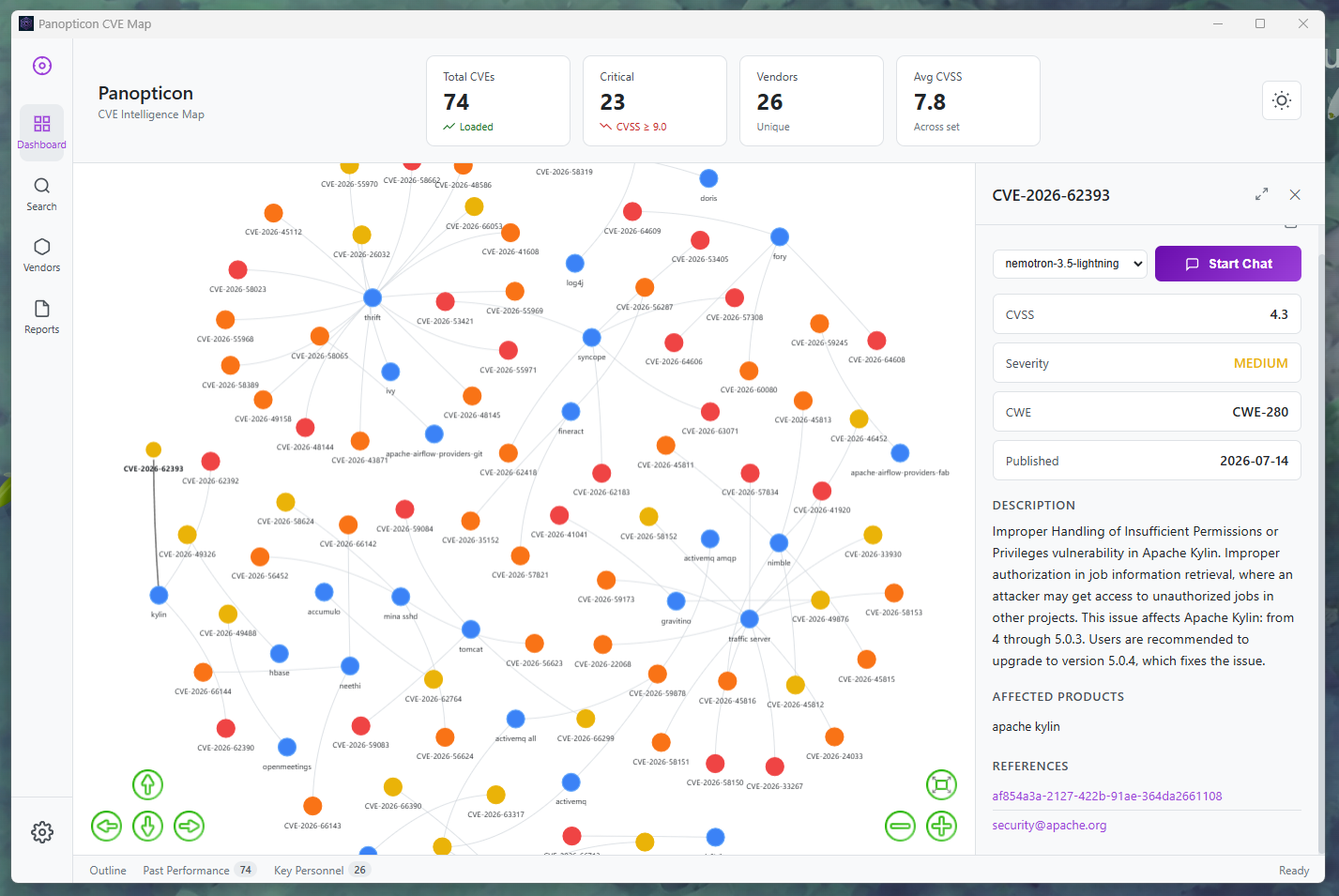 Vendor↔CVE force-directed graph · camera focus on critical node · light theme
Vulnerability triage today is a browser tab soup: NVD, vendor advisories, CISA KEV, ChatGPT, internal runbooks — all in separate windows. The analyst context-switches constantly and the mental model of "this CVE, this vendor, these affected products, these mitigations" never lives in one place.
Panopticon collapses that into a single native surface:
- Spatial memory — the graph is the mental map; clicking a CVE recenters the world around it.
- Stateful analysis — the AI remembers the conversation and the CVE context simultaneously.
- Resumable work — close the app, open it tomorrow, pick up exactly where you left off.
- Prioritized triage — KEV flags cut through CVSS noise: exploited beats theoretical.
- Local by default — no telemetry, no SaaS middleman, your keys stay on your disk.
┌─────────────────────────────────────────────────────────────────┐
│                    Vanilla JS (Vite + vis-network)              │
│                                                                 │
│   invoke("chat_with_agent", { cveId, messages, model })         │
└────────────────────┬────────────────────────────────────────────┘
                     │
                     ▼
┌─────────────────────────────────────────────────────────────────┐
│              Tauri 2  ·  Rust command handlers                  │
│                                                                 │
│   async fn chat_with_agent(cve_id, messages, model)             │
└────────────────────┬────────────────────────────────────────────┘
                     │ spawn python.exe · history via stdin
                     ▼
┌─────────────────────────────────────────────────────────────────┐
│                     Python asyncio layer                        │
│                                                                 │
│   ai_agent.py ──► MCP client ──► mcp_server.py (CVE context)    │
│        │                              │                         │
│        │                              ├─► SQLite (local CVE DB) │
│        │                              └─► CISA KEV catalog      │
│        │                                    + NVD live fallback │
│        └──► OpenRouter API  +  SQLite (chat_reports)            │
└─────────────────────────────────────────────────────────────────┘
The Rust layer is deliberately thin: it owns the window, routes IPC, and spawns Python processes. All heavy logic (LLM orchestration, graph building, search, persistence) lives in Python, which is easier to iterate on for ML-adjacent work.
Panopticon/ # repo root = desktop project
├── src/ # Vanilla JS + CSS
│ ├── main.js # UI, graph, chat, panels, reports
│ └── styles.css # Dark/light theme (purple accents)
├── src-tauri/ # Rust shell + IPC commands
│ ├── src/lib.rs # Thin handlers: routing + process spawn
│ └── tauri.conf.json # Window defaults, permissions
── panopticon-python/ # Backend
│ ├── ai_agent.py # LLM orchestration + MCP client
│ ├── mcp_server.py # MCP tools: CVE context, KEV, CWE stats
│ ├── graph_builder.py # Vendor↔CVE graph export + KEV flags
│ ├── global_search.py # Cross-table search
│ ├── get_vendors.py # Vendor list with CVE counts
│ ├── save_report.py # chat_reports CRUD + migrations
│ ├── ingestor.py # NVD → SQLite rolling-window pipeline
│ ├── db.py # Schema + atomic inserts
│ ├── config.py # Env-driven constants
│ ├── utils.py # Secret masking + degenerate-repetition helpers
│ ├── seed_mock.py # 50 synthetic CVEs for demos
│ └── panopticon.db # (auto-created, gitignored)
├── docs/
│ └── img/ # README + article screenshots
├── index.html
├── vite.config.js
└── package.json
- Tauri 2 — native desktop shell
- vis-network — force-directed graph rendering
- MCP — tool-use protocol for LLM context
- OpenRouter — multi-model gateway (free tier)
- CISA KEV — exploited-vulnerability catalog
- SQLite — zero-config local persistence
- Streaming LLM responses via Tauri Events (no UI micro-freeze on long reports)
- In-UI "Sync" button with live ingest log stream (Tauri Events)
- Persist CISA KEV catalog to a local table (zero-latency flags, offline mode)
- CWE layer in the graph (vendor weakness patterns)
- Dashboard trends: 7/30-day publication spikes, top vendors
-
json_repairintegration for malformed LLM outputs - OS-level secret storage (replace
localStorageAPI keys) - Encrypted
.panopticonexport/import for team handoffs - CI release builds (GitHub Actions artifacts per OS)
Read the full architectural breakdown on dev.to: Building Panopticon: A Local-First CVE Intelligence Map with Tauri 2 + Rust + Python
Covers sampling penalties for LLM repetition collapse, stdin transport bypassing Windows CLI limits, CISA KEV projection bugs, and why vanilla JS won over React for this tool.
- tauri-ui — inspired the dark/purple visual direction and the README structure
- GooEye — sibling project: a stealth sniper bot for 闲鱼(Goofish)
Built something with Panopticon's architecture? Open a PR adding it to this list — one line with a link and a short description.
MIT