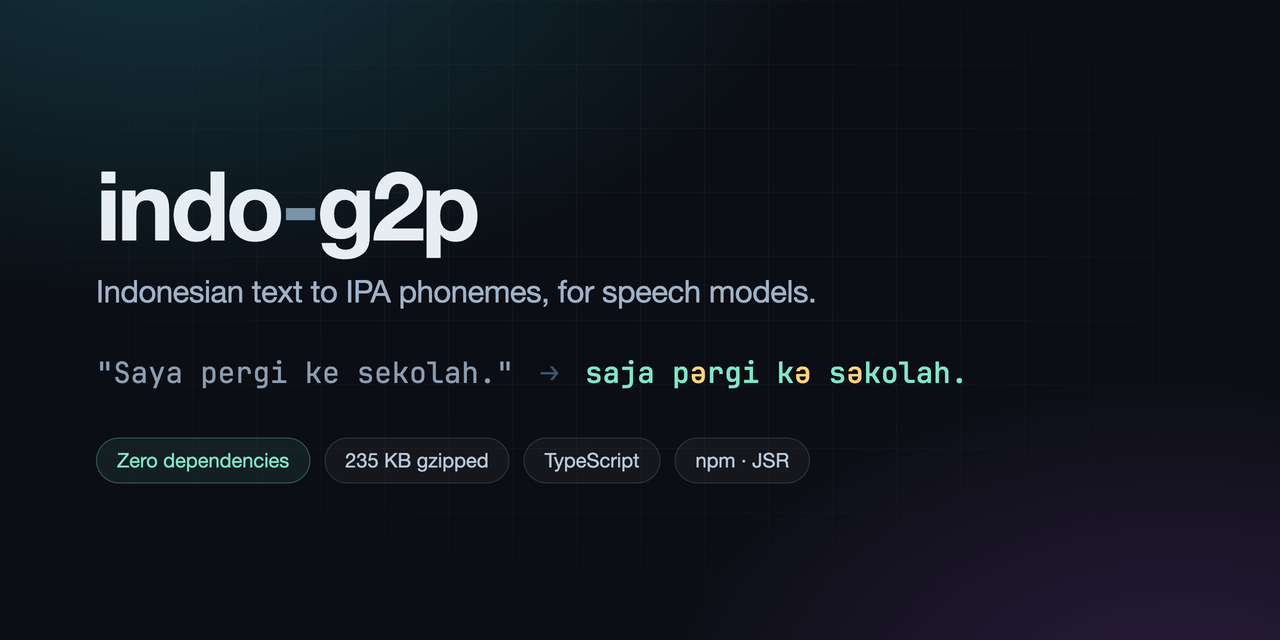







Turn Indonesian text into IPA phonemes and syllables, ready for a speech model. TypeScript, zero dependencies, runs anywhere.
import { toPhoneme } from "indo-g2p";

const { phonemes } = toPhoneme("Tak seorang pun boleh ditangkap.");
// "taʔ səoraŋ pun boleh ditaŋkap."
Contents
Indonesian looks phonetic and is not. One letter spells two different vowels,
k is usually a glottal stop, and some spellings have two readings. A plain
letter-to-sound mapping gets all three wrong, and a speech model trained on
that output learns the mistake.
Both e sounds |
pergi is pərgi, kaget is kaget. A dictionary, a lexicon and affix rules place the schwa; only 6.0% of running text is left without evidence. |
| Homographs from context | upacara apel is apel, makan apel is apəl. Rules are checked against Wiktionary and abstain rather than guess. |
| Syllables you can use | Boundaries are placed for real phoneme strings, not just clean ones: 0.2% of dictionary words collapse to a single syllable. |
| Messy text, not clean text | Harga Rp15.000 naik 20%. becomes harga lima bəlas ribu rupiah naɪʔ dua puluh pərsen. |
| Loanwords read as English | event is ifent, not efent, behind filters that keep jakarta and april Indonesian. |
| Nothing at runtime | Zero dependencies, no native modules, no model downloads. Node, Bun, Deno, browser. |
| Signed supply chain | npm provenance, a CycloneDX SBOM and a cosign signature on every release. |
Try it in the browser before you install. Wiring this into an agent or a pipeline? Start with the AI agent guide: the whole API, the failure modes and the determinism guarantees on one page.
bun add indo-g2p        # npm i indo-g2p
deno add jsr:@snowfluke/indo-g2p
Three entry points, so a bundle carries only the tables it uses:
| Entry point | What it adds |
|---|---|
indo-g2p/core |
the converter, 235 KB gzipped |
indo-g2p |
the same, plus English word readings |
indo-g2p/homographs |
the part-of-speech homograph resolver |
import { toPhoneme } from "indo-g2p";

const { phonemes, syllables } = toPhoneme(
  "Tak seorang pun boleh ditangkap, ditahan atau dibuang dengan sewenang-wenang."
);

console.log(phonemes);
// taʔ səoraŋ pun boleh ditaŋkap, ditahan ataʊ dibuaŋ dəŋan səwənaŋ-wənaŋ.

console.log(syllables.slice(0, 6));
// [ "taʔ", " ", "sə", "o", "raŋ", " " ]
Text is lowercased first. Punctuation, digits, and spacing pass through
unchanged. Each word in syllables is followed by a single " ".
A word with no valid consonant/vowel shape is read letter by letter, but only when you ask for it:
toPhoneme("tv").phonemes; // "tf"
toPhoneme("tv", { expandAbbr: true }).phonemes; // "téfé"import { toSyllables } from "indo-g2p";
toSyllables("sekolah"); // [ "se", "ko", "lah" ]Syllable boundaries get special care here, because the obvious approach has a bug that matters for text-to-speech.
The CRF syllabifier was trained on text with the digraphs already mapped, ng
to ŋ, but with no schwa marking. g2p-id feeds it its own output, schwa
included, and the model responds by predicting almost no boundaries at all.
indo-g2p folds ə back to e for tagging only, and refuses a boundary
inside the two-character affricates tʃ and dʒ.
Measured over the 17,888-word schwa dictionary:
| g2p-id | indo-g2p | |
|---|---|---|
| words collapsed to one syllable | 2,706 (15.6%) | 35 (0.2%) |
boundary inside tʃ or dʒ |
975 | 0 |
cerdas    tʃərdas    g2p-id: tʃərdas       here: tʃər|das
cerca     tʃərtʃa    g2p-id: tʃərt|ʃa      here: tʃər|tʃa
sekolah   səkolah    g2p-id: səko|lah      here: sə|ko|lah
phonemes is untouched by this.
import { toGrapheme } from "indo-g2p";

toGrapheme("ditaŋkap"); // "ditangkap"
This is best-effort. Both /ə/ and /e/ spell as e, and a glottal stop
always spells as k, so the round trip is lossy.
Every row below is generated by running the input through toPhoneme with
default options, so it cannot drift from what the library does. Regenerate with
bun run coverage.
| Covers | Input | Output |
|---|---|---|
| Ordinary vocabulary | sekolah |
səkolah |
| Schwa from the dictionary | dengan |
dəŋan |
| Schwa in a derived word not in any word list | tersebut |
tərsəbut |
| Schwa through a prefix | memperbaiki |
məmpərbaiki |
| Passive prefix | digelar |
digəlar |
| Syllables see the syllables column | cerdas |
tʃərdas |
| Covers | Input | Output |
|---|---|---|
| Digraphs | nyanyi syarat khusus |
ɲaɲi ʃarat xusus |
| Affricates | cacing jajan |
tʃatʃiŋ dʒadʒan |
| Diphthongs | pulau pandai amboi |
pulaʊ pandaɪ ambɔɪ |
| Glottal stop | rusak bakso rakyat |
rusaʔ baʔso raʔjat |
kh is not a glottal stop |
akhir |
axir |
kr and kl are not either |
demokrat iklan |
demokrat iklan |
| Covers | Input | Output |
|---|---|---|
| Homograph, by context | upacara apel di lapangan |
upatʃara apel di lapaŋan |
| The same word, other sense | dia makan apel merah |
dia makan apəl mərah |
| Homograph with a number between | apel 17 agustus di lapangan |
apel tudʒuh bəlas agustus di lapaŋan |
Abbreviation, opt in expandAbbr: true |
tv |
téfé |
| Covers | Input | Output |
|---|---|---|
| Integer | 15000 |
lima bəlas ribu |
| Indonesian digit grouping | 1.234,56 |
səribu dua ratus tiga puluh əmpat koma lima ənam |
| Currency | Rp250.000 |
dua ratus lima puluh ribu rupiah |
| Percentage | naik 5% |
naɪʔ lima pərsen |
| Degrees | 50°C |
lima puluh dəradʒat tʃelsius |
| Arithmetic | 3+4=7 |
tiga plus əmpat sama dəŋan tudʒuh |
| Version, not a number deliberately not read as one | versi 1.2.3 |
fersi satu titiʔ dua titiʔ tiga |
| Date, not interpreted no date parsing | 1 April 2024 |
satu april dua ribu dua puluh əmpat |
| Covers | Input | Output |
|---|---|---|
| English word | download |
daʊnlod |
| English brand | iphone |
aɪfon |
| Western name | michael |
maɪkəl |
Name Indonesian rules mangle was dennj |
denny |
deni |
| Indonesian place name kept Indonesian | jakarta |
dʒakarta |
| Indonesian personal name kept Indonesian | lukman |
luʔman |
| Month name kept Indonesian | april |
april |
| Covers | Input | Output |
|---|---|---|
| Punctuation is kept | Halo, dunia! Benarkah? |
halo, dunia! bənarkah? |
| Typographic quotes folded | «kutipan» |
"kutipan" |
| Unreadable symbols dropped | #tagar |
tagar |
| Case is folded | Jakarta |
dʒakarta |
| Non-letters pass through | email@situs.com |
email at situs.tʃom |
Syllables come back alongside the phonemes: cerdas → tʃər · das, sekolah → sə · ko · lah, memperbaiki → məm · pər · ba · ik · i, beautiful → bju · tə · fəl.
| Export | Signature |
|---|---|
toPhoneme |
(text: string, options?: ToPhonemeOptions) => G2PResult |
toSyllables |
(word: string) => string[] |
toGrapheme |
(text: string) => string |
applySchwa |
(word: string) => string |
normalizeText |
(text: string) => string |
spellNumber |
(value: number) => string |
spellDecimal |
(whole: number, fraction: string) => string |
resolveCollocations |
(words: readonly string[]) => (string | undefined)[] |
collocationRules |
() => { word: string; triggers: string[] }[] |
lookUpEnglish |
(word: string) => string | undefined |
englishWords |
() => string[] |
VERSION |
string |
resolveHomographs /homographs |
(words: readonly string[]) => (string | undefined)[] |
knownHomographs /homographs |
() => string[] |
G2PResult is { phonemes: string; syllables: string[] }.
ToPhonemeOptions is
{ expandAbbr?: boolean; normalize?: boolean; english?: boolean; resolveSchwa?: SchwaResolver | false }, where
resolveSchwa defaults to resolveCollocations and false disables
resolution entirely.
SchwaResolver is (words: readonly string[]) => readonly (string | undefined)[].
WordTrace is { word: string; phonemes: string; source: PhonemeSource }, and
PhonemeSource is a union of the seven layer names above.
apel is /apəl/ as a noun (the fruit) and /apel/ as a verb (roll call).
Which one you get depends on the sentence, so resolution is on by default:
import { toPhoneme } from "indo-g2p";

toPhoneme("upacara apel di lapangan").phonemes; // "upatʃara apel di lapaŋan"
toPhoneme("dia makan apel merah").phonemes; // "dia makan apəl mərah"
The default resolver reads the words around each homograph. A rule fires only when one of its trigger words is within four words in the same sentence; otherwise the schwa dictionary decides. That makes a missing trigger free and keeps the whole thing to a few kilobytes with no model.
The readings come from
data/homographs-verified.tsv, each checked
against the Indonesian entry on en.wiktionary.org,
which marks the pepet vowel (ê is /ə/, é and è are not). The trigger
lists live in
data/homographs-collocations.tsv.
Turn it off with resolveSchwa: false:
toPhoneme("upacara apel di lapangan", { resolveSchwa: false }).phonemes;
// "upatʃara apəl di lapaŋan"indo-g2p/homographs swaps the collocation rules for an averaged-perceptron
POSP tagger adapted from
Bookbot's g2p_id. It covers 11 words
instead of 4, at the cost of a 3.3 MB table:
import { toPhoneme } from "indo-g2p";
import { resolveHomographs } from "indo-g2p/homographs";

toPhoneme(text, { resolveSchwa: resolveHomographs });
Measured on 176,038 tokens of Indonesian news text, the tagger changed the output of zero sentences while the collocation rules corrected three. The tagger has never seen 42 of the 57 candidate homographs in training, so it emits its unknown-word default for them and the resolver abstains. That is why it is not the default. See docs/homograph-review.md.
Any function of the same shape works, so you can bring your own:
import type { SchwaResolver } from "indo-g2p";

// Return the resolved spelling per word, or undefined to use the dictionary.
const myResolver: SchwaResolver = (words) => words.map(() => undefined);A speech model has no phoneme for 5, % or °, so those either fail or get
dropped. They are spelled out in Indonesian by default:
toPhoneme("harga Rp15.000 naik 5%").phonemes;
// "harga lima bəlas ribu rupiah naɪʔ lima pərsen"

toPhoneme("harga Rp15.000 naik 5%", { normalize: false }).phonemes;
// "harga rp15.000 naɪʔ 5%"
It handles digits with Indonesian grouping (1.234,56), currency, percentages,
degrees and arithmetic symbols, and folds typographic quotes and dashes onto
the plain ones. .,!?;:'"()- are kept, because that is what a model phrases
on; anything else with no reading is dropped.
Times and dates are deliberately not interpreted. 07.30 could be a time, a
version or a price, and guessing wrong is worse than reading the digits, so
versi 1.2.3 becomes versi satu titik dua titik tiga.
Pass normalize: false to hand the text through untouched, which is what a
caller doing its own normalisation wants. normalizeText and spellNumber
are exported for use on their own.
Indonesian writing borrows English freely, and reading those words with
Indonesian spelling rules gives efent for event. English words are read as
English instead, in the same phoneme set as everything else:
toPhoneme("event").phonemes; // "ifent"
toPhoneme("download").phonemes; // "daʊnlod"
toPhoneme("michael").phonemes; // "maɪkəl", not "mitʃael"
Two filters keep it away from Indonesian. A word is only eligible if no
Indonesian source places it, and if it is not one of the 2,082 names and
naturalised loanwords in
data/indonesian-proper-nouns.tsv. That
file is why jakarta, april and islam keep their Indonesian readings,
since English dictionaries carry those spellings too.
Names are included rather than filtered out, because Indonesian rules read
them badly: denny was dennj, a syllable with no vowel, and is now deni.
Pass english: false to switch it off, or import
indo-g2p/core to leave the 2 MB table out of
the bundle entirely.
Five sources can answer for a word, and when one of them is wrong the useful
question is which one spoke. explain answers it:
import { explain } from "indo-g2p";

explain("upacara apel di jakarta");
// [ { word: "upacara", phonemes: "upatʃara", source: "lexicon" },
//   { word: "apel",    phonemes: "apel",     source: "collocation" },
//   { word: "di",      phonemes: "di",       source: "lexicon" },
//   { word: "jakarta", phonemes: "dʒakarta", source: "rules" } ]
source is one of override, dictionary, lexicon, affix, english,
collocation or rules, and tells you where to go to fix a wrong reading:
a bad dictionary answer belongs in data/schwa-overrides.tsv, a bad
collocation in data/homographs-collocations.tsv, a wrongly-english word
in data/indonesian-proper-nouns.tsv. It takes the same options as
toPhoneme, so it reports what that call would really do.
Indonesian spelling writes /e/ and /ə/ with the same letter, so a word
list decides which is which. g2p-id ships a 17,888-word one, but the
language builds most of its vocabulary by affixing roots, and the derived
forms are not listed. On 141,770 tokens of news text, 28% of all words
were e-words it had never seen, and every one was read with a plain /e/.
Three sources answer instead, in order of how far each is trusted:
| Source | Words | Answers |
|---|---|---|
Curated dictionary, plus data/schwa-overrides.tsv |
17,888 | 32.6% of tokens |
| Bookbot's lexicon (Apache-2.0) | 22,659 more | included above |
| Affix rules, no word list at all | n/a | 1.9% of tokens |
Nothing places it, so it keeps a plain /e/ |
6.0% of tokens |
The dictionary outranks the lexicon because it is right on native vocabulary
where the lexicon is not: it reads memang, desa, merah and bebas with
a schwa, and the lexicon does not. The lexicon outranks the affix rules
because it is a word list rather than a guess, correcting both their misses
(pəmerintah to pəmərintah) and their overreach (mədia to media).
The prefixes me-, se-, te-, be-, pe-, ke-, ber-, ter-, per-
always carry a schwa. That is a fact about the language rather than about any
word list, so an unlisted word can still be read correctly:
tersebut     g2p-id: tersebut       here: tərsəbut
menjadi      g2p-id: menjadi        here: məndʒadi
mengatakan   g2p-id: mengatakan     here: məŋatakan
beberapa     g2p-id: beberapa       here: bəbərapa
The rules only run for words no list places, so every curated entry is untouched. Scored against the dictionary itself, guessing each known word as if it were missing, the prefix vowel comes out right 96.8% of the time.
Loanwords that merely begin with a prefix's letters are the failure mode. Two
things hold them back: a root has to start with a legal Indonesian onset, so
teknologi is not read as te + knologi, and
data/schwa-overrides.tsv pins the rest by hand.
That file is also where you correct the inherited dictionary itself, as it
carries mental, whose common sense is /mental/ rather than /məntal/.
A k at the end of a word, or between a vowel and a consonant, is a glottal
stop: rusak is /rusaʔ/ and rakyat is /raʔjat/. Two cases are excluded
where g2p-id applies the rule anyway.
kh is a digraph, not a k before a consonant. g2p-id reads akhir as
aʔhir, which also means its kh to /x/ mapping never sees the word:
akhir      g2p-id: aʔhir       here: axir
terakhir   g2p-id: təraʔhir    here: təraxir
makhluk    g2p-id: maʔhluʔ     here: maxluʔ
kr and kl are Latin onset clusters, and a native Indonesian root does not
form them across a syllable break, so a word that reaches them is borrowed:
demokrat   g2p-id: demoʔrat    here: demokrat
iklan      g2p-id: iʔlan       here: iklan
nuklir     g2p-id: nuʔlir      here: nuklir
The clitic -lah is the exception, because there the k really does end a
root: tidaklah stays /tidaʔlah/.
| Step | What it does |
|---|---|
| Schwa lookup | 17,888-word dictionary decides which e is /ə/ and which is /e/ |
| Glottal stop | A final k, or a k between a vowel and a consonant, becomes /ʔ/ |
| Phoneme map | ng→ŋ, ny→ɲ, sy→ʃ, c→tʃ, j→dʒ, kh→x, v→f, y→j, x→ks |
| Syllabify | A CRF tagger labels each character as continuing or closing a syllable |
| Diphthongs | Inside a syllable, ai→aɪ, au→aʊ, oi→ɔɪ |
Every model ships as plain weights in src/data/, unpacked from its original
binary. Nothing is fetched at runtime.
| Table | Size | Loaded |
|---|---|---|
| Schwa dictionary | 206 KB | on first toPhoneme with an e |
| CRF syllabifier | 295 KB | on first toSyllables |
| POSP tagger | 3.3 MB | only via indo-g2p/homographs, and only when a homograph appears |
| English table | 2.0 MB | only via indo-g2p, never via indo-g2p/core |
english: false turns the English lookup off, but a static import cannot be
argued out of a bundle, so the data ships anyway. Import indo-g2p/core
instead and the table is never referenced:
| Import | Minified | Gzipped | English words |
|---|---|---|---|
indo-g2p |
2.69 MB | 887 KB | read as English |
indo-g2p/core |
0.72 MB | 235 KB | read by Indonesian rules |
Both entry points expose the same API, minus lookUpEnglish and
englishWords, and agree on every Indonesian word. indo-g2p/core is the
better default for a browser bundle; take the full entry point when the input
mixes in English, which Indonesian writing usually does.
The part-of-speech tagger is separate again: it lives behind
indo-g2p/homographs and reaches neither bundle above. Both figures come from
minifying a consumer that imports the whole public API of each entry point,
then checking the output for each table's symbols.
These are inherited behaviours indo-g2p keeps rather than fixes:
- Only
[a-z]runs are converted. Accented and non-ASCII input passes through like punctuation, so it belongs to no syllable. - Digits and symbols are spelled out unless
normalize: falseis set. - No stress marks are emitted. Indonesian stress is not contrastive, and a speech model learns the symbol set it is trained on, so adding them would enlarge the vocabulary for nothing.
- The name list has holes. Any place, brand or surname missing from
data/indonesian-proper-nouns.tsvand present in the English dictionary gets an English reading. Adding one is a one-line edit. - The syllabifier is a CRF model and still gets words wrong, for
example
dəŋ|anrather thandə|ŋan. It is a character model with no notion of Indonesian morphology. - The default collocation rules cover 4 words. They only fire on a lexical trigger, so a syntactic case like mereka tetap apel seperti biasa is left to the dictionary rather than guessed.
- The part-of-speech resolver covers 11 words. g2p-id ships 102 entries;
45 have identical readings or share a part of speech, and of the 57 that
remain, 27 have no pepet-marked Wiktionary entry, 16 turn out to have one
pronunciation across every sense, and 3 contradict the inherited mapping.
python3 scripts/verify-homographs.pyreproduces every verdict. Guessing on the unverifiable ones made the output worse, not better. - The tagger is the weak link, not the rules. 42 of the 57 candidate homographs
never appear in the POSP corpus the tagger was trained on, so it emits its
unknown-word default for them. The resolver therefore requires the tag to
match one of an entry's two verified classes and abstains otherwise. A larger
model does not help: a fine-tuned transformer tagger labels
apelandgantengexactly the same way. - Rare senses stay unreachable.
peningreally does mean both "dizzy" and "tax plate", but the tagger reads the common adjective as a noun, so only the adjective side ships. - The resolver sees words only, not punctuation, so context differs slightly from a tagger fed a full tokenizer stream.
bun install
bun test          # includes the Python parity fixtures
bun run lint
bun run fmt
bun run type-check
bun run build       # emits lib/ for npm
bun run demo        # serves the demo at localhost:3000
bun run build:site  # emits site/ for GitHub Pages
The demo deploys to GitHub Pages from .github/workflows/pages.yml on every
push to main. Enable it once under Settings > Pages > Source: GitHub Actions.
src/data/ is generated. Regenerate with the dev-only scripts:
uv run --with python-crfsuite scripts/dump-model.py    ../g2p-id
uv run --with python-crfsuite scripts/dump-fixtures.py ../g2p-id
python3 scripts/dump-pos.py .
CONTRIBUTING.md covers the parity contract and the bar for a homograph rule. SECURITY.md covers reporting and release verification. GOVERNANCE.md covers who decides what.
MIT. See LICENSE and NOTICE.md.
indo-g2p began as a study of Wikidepia/g2p-id (MIT) and owes it the original idea, the CRF weights and the schwa dictionary. The perceptron POS tagger and the homograph table come from bookbot-kids/g2p_id (Apache-2.0). English pronunciations come from open-dict-data/ipa-dict (MIT), and the homograph readings are checked against en.wiktionary.org.
The rules, the corrections and the layering above those inputs are this project's own, and it is developed on its own terms rather than tracking any other implementation.