The live attention layer for Paperclip, combining Aperture Core continuity with Paperclip-native operator policy.




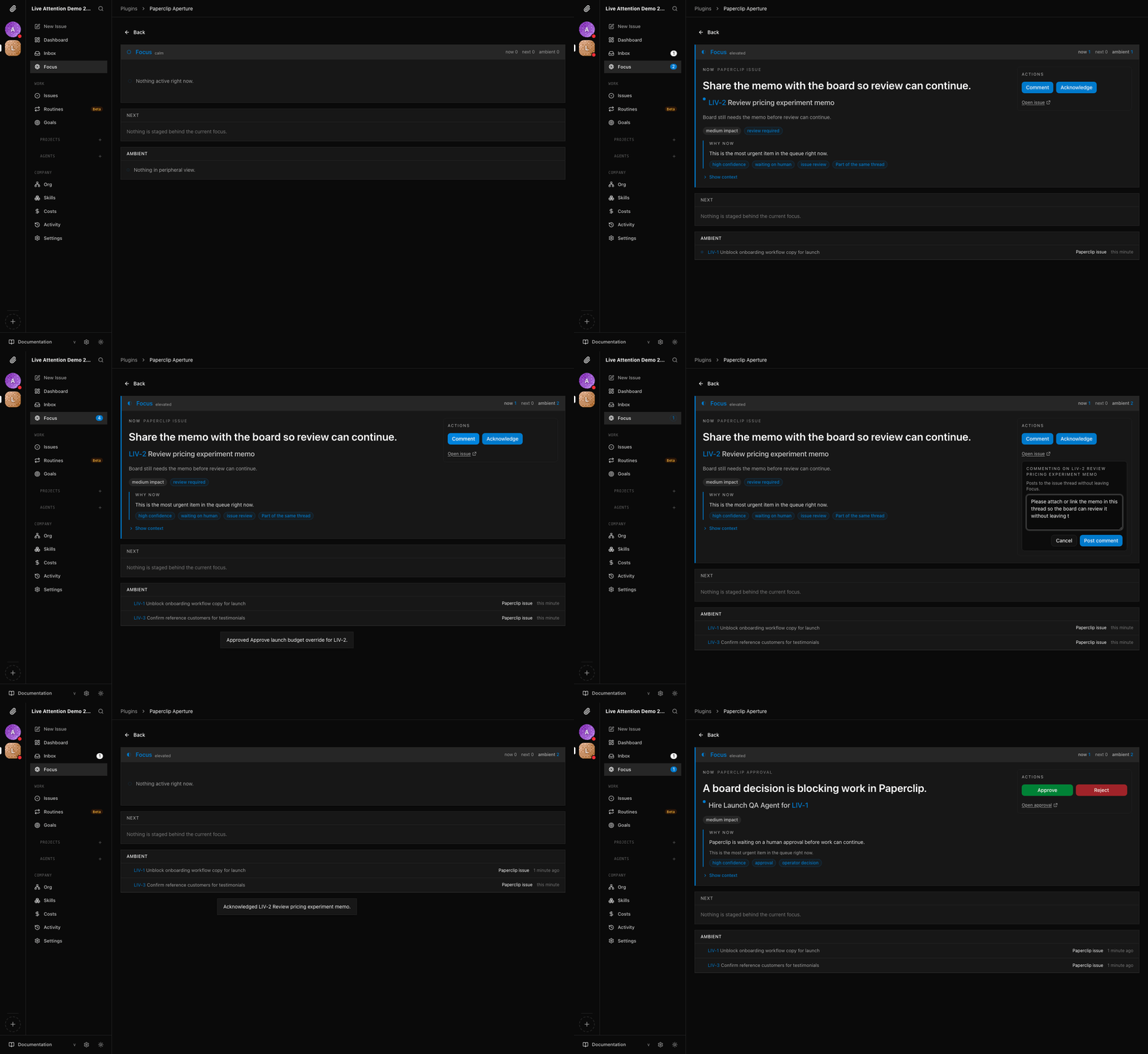
Paperclip Aperture adds a Focus surface to Paperclip that turns approvals, issue activity, and other human-facing signals into now, next, and ambient.
It is designed as a live attention layer, not an inbox clone:
nowshows the single most interrupting itemnextstages the queue behind itambientkeeps low-pressure awareness visible without demanding action- unread state is secondary to action pressure, so Focus stays judgment-first instead of becoming a second inbox
Put differently:
- Inbox tells you what changed
- Focus tells you what deserves attention now
- Inbox mirrors source records
- Focus re-stacks them into an operator-facing queue with recommended moves
npx paperclipai plugin install @tomismeta/paperclip-apertureIf you need Paperclip first:
npx paperclipai onboard --yes
npx paperclipai run
Then install the plugin with the command above.
After install, open Paperclip and use the Focus entry in the sidebar.
- If the sidebar shows a bordered placeholder instead of the
Focusentry, upgrade to Paperclip2026.525.0or newer and reinstall this plugin.0.4.5+preserves the original Focus sidebar icon and uses the current host invocation scope. paperclipApiBaseis only needed for approval overlays. Use the Paperclip origin such ashttps://HOSTorhttp://127.0.0.1:3100; leaving it empty disables approval overlay reads without disabling Focus.- On Windows,
spawn npm ENOENTduringnpx paperclipai plugin install @tomismeta/paperclip-aperturecomes from the Paperclip host installer failing to spawn npm. This package does not spawn npm during install. Make sure the Paperclip process can resolvenpm.cmd, or upgrade Paperclip once the Windows installer fix is available.
+--------------+   +--------------+   +--------------+   +--------------+   +--------------+
| Arrive       |   | Translate    |   | Judge        |   | Show         |   | Respond      |
| events       |   | facts        |   | attention    |   | surface      |   | action       |
+--------------+   +--------------+   +--------------+   +--------------+   +--------------+
       |                  |                  |                  |                  |
       +----->            +----->            +----->            +----->            |

tool hooks         explicit facts      does this         what the          operator decision
from Paperclip     from raw payloads   deserve           operator          carried back
and agents                             attention now?    actually sees     to the tool
- a Focus surface inside Paperclip
- ranked
now,next, andambientattention lanes - embedded explainability in the Focus UI, including
Why now,Why next, confidence, signals, thread context, and related activity - bounded focus hold while the operator is actively working the current
nowitem, soShow contextand inline commenting do not immediately lose the thread beneath them - approval handling, including budget-specific approval semantics
- issue-aware operator language such as
review required,blocked, and targeted recommended moves - agent-aware routing that distinguishes known company agents from human/operator roles when issue text references them
- a plugin-local semantic mapping and policy layer that interprets Paperclip issue, approval, and agent signals before composing the final Focus view
- richer semantic continuity hints on mapped issue events, including
supersedesandresolvesrelationships where Paperclip-specific intent is clear - document-aware review interpretation for memo/spec-backed issues so Focus can tell the difference between
review is blocked on the artifactandthe artifact is attached, monitor instead - dynamic re-stacking so items can move between
now,next, andambientas new evidence arrives - inline issue commenting from the Focus surface when a Paperclip issue supports written response
- durable acknowledge/suppression behavior backed by plugin state and ledger replay
- worker-owned display composition that merges live Paperclip approvals into the final Focus snapshot before the UI sees it
- bounded Core trace export and sparse Focus action telemetry/activity writes for replay and debugging
- live Core diagnostics export, including signal summaries, memory profile snapshots, and current-session attention state for offline analysis
- worker-bridged operator signals for Focus page presence, active-item viewing, and context expansion so Aperture Core sees real interaction evidence instead of the plugin faking a second attention model
- overlay diagnostics export that compares
core -> reconciled -> displayso the plugin's host-policy contribution is inspectable without confusing it for Core judgment - a sidebar entry, page, and dashboard widget
- worker-side host read caching for issue/comment/document/agent reconciliation, with fresh summary/export reads when you need the latest host truth
- bounded per-company Core sessions with health reporting so the worker does not grow without limit during normal multi-company use
- replayable operator signal entries and overlay-response ledger entries so Focus actions remain auditable even when a frame came from the display adapter rather than Core
- decision-owner metadata on reconciled/display frames so exports can distinguish Core judgment, Paperclip reconciliation, approval overlays, and final display promotion
- a corpus-backed
issue-intelligenceregression check in CI so heuristic edits stay inspectable - rollback-safe local mutations that restore the last durable attention state if persistence fails
- versioned persisted attention envelopes with an explicit migration path for older schemas
Focus is meant to be more legible than a smart inbox.
The current 0.4.x explainability slice keeps reasoning attached to the cards you are already acting on:
Why nowon the active card explains why the current item outranks the rest of the queueWhy nexton queued rows explains why something is staged behind the current top itemConfidenceshows how strong the semantic signal is when the plugin has oneSignalssurfaces the specific factors that pushed the item into attentionThread contextandRelated activityhelp explain whether an item is part of a broader episode or continuation
The intent is not to expose every internal scoring detail. It is to help an operator answer:
- why did this surface?
- why is it in this lane?
- how much should I trust this judgment?
This plugin treats Paperclip as the host runtime and UI shell, while embedding Aperture Core through the npm package @tomismeta/aperture-core.
It is an SDK-first integration with explicit plugin-side host policy. Aperture Core handles continuity, replay, and global attention mechanics; the plugin adds Paperclip-specific candidate generation, approval overlays, and operator language where the host can know more than Core alone.
For 0.4.x, the boundary works like this:
- the plugin worker owns Aperture ingestion, replay, review state, display composition, reconciliation caching, and Paperclip-native policy overlays
- the final Focus view is therefore Core-backed but not Core-only today: the plugin still owns some Paperclip-specific candidate and lane policy where the host has facts Core cannot infer by itself
- Paperclip remains the system of record for issue and approval writes
- approval transport now goes through a worker-side Paperclip adapter using the plugin SDK HTTP client, so the browser UI no longer talks to host approval APIs directly
- the plugin preserves Paperclip source facts as
SourceEvents where the Core contract supports them, while still exporting the normalizedApertureEventused for replay/debug - that semantic layer includes reusable intent detectors, actor resolution against real company agents, downstream blocker extraction, explicit rule ids for matched issue heuristics, and shared operator-language generation inside the plugin
- typed Paperclip issue blocker relations are preserved as Focus context/provenance/metadata so Aperture has better dependency facts without the plugin inventing dependency routing
activity.loggeddocument events invalidate stale reconciled state so document-backed review blockers refresh promptly without a full browser-side merge layer- Paperclip
agent.error_clearedevents invalidate reconciled agent state, and redacted deleted comments are ignored when Focus chooses the latest operator signal - subscribed event callbacks stay memory-only and flush pending Aperture state from the next scoped data/action bridge call, keeping host invocation scope boundaries intact without losing replay durability after Focus refreshes
- Focus exports the live Core snapshot, the reconciled/plugin-composed display snapshot, and bounded Core traces so replay/debug flows can inspect both the engine substrate and the final operator view
The plugin requires Paperclip 2026.525.0 or newer and has been validated against @tomismeta/aperture-core@0.7.0 and @paperclipai/plugin-sdk@2026.609.0.
Approval overlay transport is opt-in until the Paperclip plugin SDK exposes a first-class approval client. Set the plugin config field paperclipApiBase when the worker can reach the host approval API; leave it empty to run Focus without approval overlays in hosted or restricted-network environments.
pnpm install
pnpm verify
Before releasing, run:
pnpm clean
pnpm release:check
pnpm verify runs typecheck, tests, the issue-intelligence eval corpus, a production build, and bundle-size checks.
For a live local Paperclip smoke test, start Paperclip first:
pnpm build
npx paperclipai run -i default
Then, in a second terminal:
npx paperclipai context set --api-base http://localhost:3100
npx paperclipai plugin uninstall tomismeta.paperclip-aperture --force
npx paperclipai plugin install --local .
If you want to smoke test approval overlays locally, set the plugin config field paperclipApiBase to http://127.0.0.1:3100 before creating approval fixtures. Without that config, Focus intentionally skips approval API reads and stays quiet.
Then open http://127.0.0.1:3100/APE/aperture and verify:
Acknowledgehides the active card and survives refreshNextpromotes intoNow- issue comments post successfully from Focus
- approval actions update Focus correctly when
paperclipApiBaseis configured - resolved blocker comments downgrade stale
Nowitems - attached issue documents downgrade stale
share the memo/specreview blockers into monitor-only follow-up - deleted issue comments do not displace the latest visible operator signal
- clearing an agent error removes stale agent-error focus cards
- the active card exposes
Why now - expanded queued rows expose
Why next
- Plugin on npm:
@tomismeta/paperclip-aperture - Roadmap and releasing: docs/ROADMAP.md
- Architecture remediation note: docs/AUDIT-REMEDIATION-2026-04.md
- May 2026 audit remediation note: docs/AUDIT-REMEDIATION-2026-05.md
- Contribution guide: CONTRIBUTING.md
- Aperture GitHub repo: tomismeta/aperture
- Aperture Core on npm:
@tomismeta/aperture-core - Paperclip GitHub repo: paperclipai/paperclip