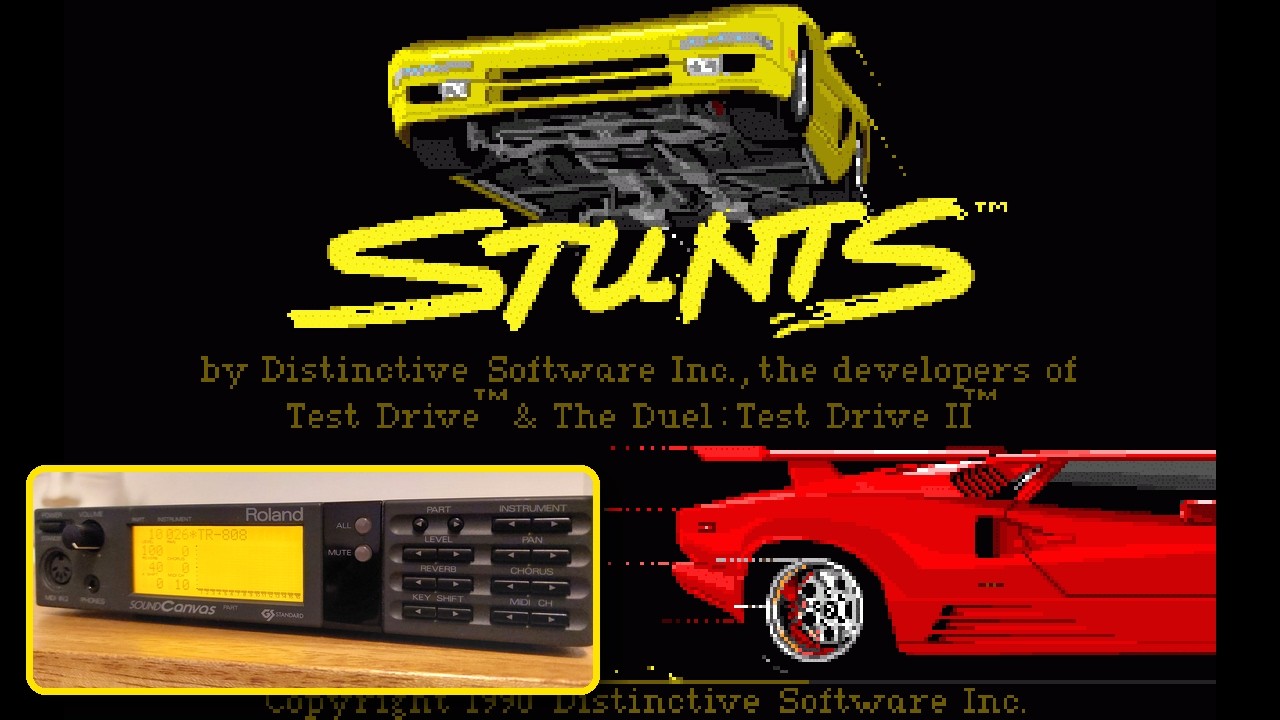
A Roland Sound Canvas driver for the Stunts DOS game.
The original Stunts shipped with a great driver list for the time:
- PC Speaker
- Tandy Sound
- AdLib / Sound Blaster (Yamaha OPL2)
- The glorious Roland MT-32
This adds one for the Sound Canvas. It uses the General MIDI set for the music, plus the GS variation sets for the in game effects, so it should sound right on any Sound Canvas compatible, starting with the SC-55.
Click to hear and see the YouTube video:
Copy three files from bin/ into your game directory:
SC15.DRVSCSKIDMS.VCESCENG1.VCE
To easily select the driver for game usage, see skidset.
Then start the game like a neanderthal:
LOAD.EXE /u MCGA /ssc
You'll probably know the flags here.
- I'm not a musician, that should say a lot.
- The first notes on the menu music may sound a little off.
- Effects are limited to the GS set, there's probably room for enhancement if we manipulate the effects better.
- Music is too compressed, which means that I need to work in some dynamic range.
- Title music is great, however the end may be a little bit abrupt. Not an issue to be honest, but there is room for improvement.
- I don't own a physical Roland Sound Canvas, so the development and test were made with DOSBox Staging 0.83.0-RC1, Nuked SC-55 and the Roland Sound Canvas VA.
If you want to build the software yourself, we provide a batch file per tested
compiler and a Makefile for Unix-like systems.
make                the tooling and the voice banks
make driver         the driver; needs TASM and a flat binary linker
Any C89 compiler builds the tooling; CC and CFLAGS override the defaults.
For the driver, point TOOLS at a directory holding tasm32.exe and
wlink.exe.
MSCBUILD          Microsoft C 5.10, 16-bit, large model
TCBUILD           Turbo C 2.01, 16-bit, large model
WCLBUILD          Open Watcom 1.9, 16-bit
WCLBUILD 386      Open Watcom 1.9, 32-bit, extender built in
Set MSCDIR, TCDIR or WATCOM to your installation. If unset, the script
looks for the compiler in the default location. These are the same compilers
skidset and skidpack build with, and every build is checked the same way:
SCCHECK reports 103 checks whichever compiler produced it.
WCLBUILD WIN32 Open Watcom 1.9, Win32 console
Any modern toolchain should work with the Makefile. Example with MinGW-w64:
mingw32-make CC=gcc
| Command | Purpose |
|---|---|
sc15 mkvce <spec> <out.vce> |
build a voice bank from a text specification |
sc15 cfg <SC15.DRV> [field=value] |
change port, gm, gs, volume |
sc15 kms <song.kms> [-events] |
read a song's tracks and events |
sc15 block <driver.drv> |
show the skidset block and check it |
make test           50 checks against the built driver
make selfcheck      103 checks against the tooling
make release-check  what ships in bin/ is what this source builds
make parity         sc15 block against skidset's own reader
make parity needs a skidset checkout: make parity SKIDSET_DIR=../skidset.
- bin/README.md: the shipped files, and rebuilding the voice banks from your own game copy
- docs/driver.md: the driver ABI, the implementation, and the skidset driver block
- docs/instruments.md: the instrument mapping
- docs/story.md: how the music came to sound right, with the recordings in docs/audio/
- docs/testing.md: what each test suite actually checks, and the DOSBox setups
- docs/develop.md: findings about the game itself
- UnifiedMT15 by LowLevelMahn: a
reverse engineered
MT15.DRVin C, used as inspiration. - restunts: the disassembly the engine side of the ABI, the container format and the KMS event format were read from.
- Nuked SC-55 by nukeykt, and its integration into DOSBox Staging.
A massive thanks to all the members of the ZakStunts community and the Stunts Forum, who keep the game alive. Without them there would be no reason to write a new driver for it.
MIT. See LICENSE.