
This repository showcases the decoder-based component of our final group project for CS614: Generative AI with Large Language Models at SMU MITB. The focus of this repo is on the decoder model development and deployment that I personally worked on, which includes:
- Fine-tuning a LLaMA 3.1 8B Instruct model using Unsloth and LoRA.
- Deploying the fine-tuned model in a Streamlit web application for real-time essay evaluation.
The complete project involved other components such as encoder-based models and prompt-based inference; however, this repository focuses only on the decoder-based contributions.
.
├── automated-essay-scoring-unsloth-finetune.ipynb   # Notebook for fine-tuning the LLaMA model
├── automated-essay-scoring-streamlit-unsloth.ipynb  # Notebook for deploying the Streamlit demo
├── README.md                                        # This file
The project aims to create an open-source Automated Writing Evaluation (AWE) system that provides consistent, explainable, and scalable essay scoring using Large Language Models.
Key characteristics of our approach:
- Built on open-source models (LLaMA 3.1 Instruct 8B).
- Prioritized parameter-efficient fine-tuning via LoRA and Unsloth for resource-friendly adaptation.
- Emphasized real-time usability through a minimal Streamlit demo.
We fine-tuned the LLaMA 3.1 8B model using Unsloth, applying Low-Rank Adaptation (LoRA) with different ranks and alpha configurations.
| Method | LoRA Config | Training Time | QWK | Accuracy | Soft Accuracy |
|---|---|---|---|---|---|
| Prompt-based (Few-Shot) | N/A | N/A | 0.666 | 0.286 | 0.806 |
| Fine-tune (Unsloth) | r=64, α=64, 1 epoch | 4h 7m | 0.925 | 0.592 | 0.990 |
- QWK: Quadratic Weighted Kappa (our primary metric)
- Fine-tuned models showed a ~39% improvement over the best prompt-based approach.
- Optimal balance achieved with r=64, suggesting the need for more expressive LoRA adapters for essay quality assessment.
- Training loss showed temporary spikes but converged well.
- Validation loss remained stable with no signs of overfitting after 1 epoch.
- Targeted all attention modules, not just
q_projandv_proj. - Used learning rate of
2e-4and applied dropout for regularization.
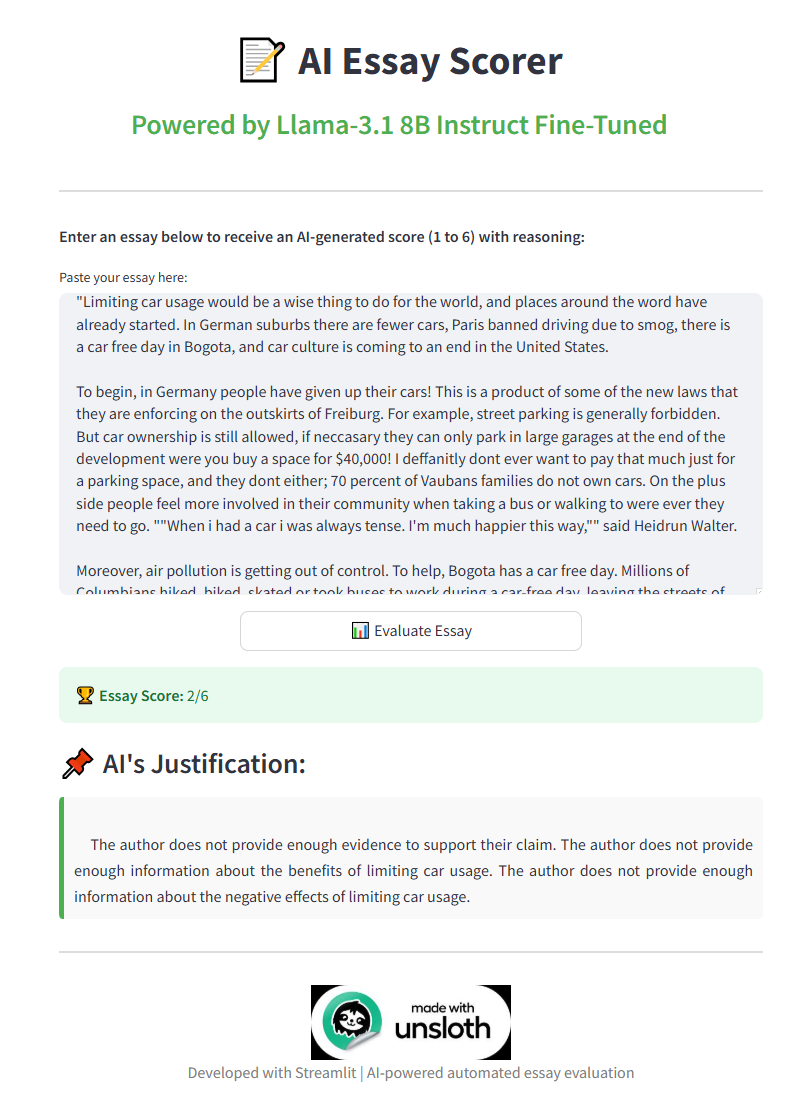
A minimal Streamlit web application was built to deploy and test the fine-tuned model.
- Input your essay in a text area.
- Click "Evaluate Essay" to generate:
- A holistic score from 1 to 6.
- A justification explaining the score.
- Hosted on Kaggle Notebooks with Tesla P100 GPU (16GB VRAM).
- Model inference takes around3 to 5 seconds per essay.
| Metric | Description |
|---|---|
| QWK | Penalizes large misclassifications more heavily. |
| Spearman's correlation | Measures ranking consistency between predicted and actual scores. |
| Accuracy | Exact score matches. |
| Soft Accuracy | Accepts predictions within ±1 of the true score. |
- Learning Agency Lab - Automated Essay Scoring 2.0 from Kaggle
- Final fine-tuning used a balanced sample of ~1,000 essays across all score levels (1-6).