English | 한국어
A lightweight Java web framework built from scratch to demystify how Spring works under the hood. Now with fully working NIO & hybrid servers and an async WebSocket stack. Still opinionated about clarity · hackability · extensibility.
Scope: Focused on container/AOP/web/server internals. A full ORM is intentionally out of scope for v1.0 to keep the surface area small and the code easy to audit.
| Area | Status & Highlights |
|---|---|
| IoC / DI Container | • Scans @Component, @Service, @Controller, @Repository, @Configuration, @Aspect.• Constructor‑based injection. • Automatic List<T> population with @Order support.• Cyclic‑dependency detection (topological sort). • Auto‑configuration via BeanDefinitionRegistrar for sensible defaults. |
| Bean Definitions | • ConstructorBeanDefinition & MethodBeanDefinition.• Factory‑method or ctor strategy. • Ctor‑meta cache → safe proxying for required‑args constructors. |
| AOP | • Annotation‑driven (@Before, @After, @Around).• AspectJ‑style pointcuts ( *, .., ?).• Advisor/Advice/Pointcut hierarchy inspired by Spring. • CGLIB subclassing + Objenesis fallback (no no‑arg ctor required). • Ordered advisor chain, proxy‑per‑target. |
| Configuration Proxy | CGLIB proxy for @Configuration(proxyBeanMethods = true) → caches repeated @Bean calls. |
| Web Layer (HTTP) | • Declarative routing (@GetMapping, @PostMapping, … + {var} patterns).• ArgumentResolvers for @PathVariable, @RequestParam, @RequestBody, …• RequestDispatcher binds → invokes → resolves (ResponseEntity, DTO, void). |
| Server | NEW: NIO server built on java.nio.channels.• Hybrid mode: HTTP over virtual threads or classic pool, WS over NIO; you choose per config. • Blocking fallback remains for learning / simplicity. |
| Filters & Interceptors | • Servlet‑style Filter chain.• Global filters (auth, CORS, logging…). • Middleware‑like Interceptor chain.• Auto‑inject List<Filter> / List<Interceptor> into RequestDispatcher. |
| Security | • Modular auth (AuthenticationManager, AuthenticationProvider, UserDetailsService).• Username/password login via AuthenticationFilter.• Method security with @PreAuthorize (AOP based).• URL authorization via AuthorizationFilter.• SecurityContextHolder with ThreadLocal per request.• Auto‑config ( @EnableSproutSecurity). |
| Exception Handling | • HTTP exceptions (BadRequest, MethodNotAllowed, …).• @ControllerAdvice + @ExceptionHandler. • Extensible ExceptionResolver chain. |
| Data Access | • Lightweight JdbcTemplate abstraction.• HikariCP integration. • AOP‑driven @Transactional support.• TransactionManager abstraction (auto‑commit/rollback). |
| WebSocket (async/NIO) | • RFC6455 handshake + frame parser/encoder (masking, ping/pong, close). • Non‑blocking write queue, OP_WRITE toggling, graceful close after drain. • Fragmentation handling (text/binary continuation frames). • WebSocketSession abstraction + lifecycle hooks (@OnOpen, @OnMessage, @OnClose, @OnError).• Pluggable WebSocketMessageDispatcher & WebSocketArgumentResolver.• Runs on same selector loop as HTTP NIO or separately—configurable. |
| Bootstrap | One‑liner: SproutApplication.run() boots the container and starts the server. |
- Clone & build
$ git clone https://github.com/yyubin/sprout.git
$ cd sprout && ./gradlew build- Run
Java 21 + CGLIB proxies require
--add-opensflags (until we drop deep reflection):
$ java \
  --add-opens=java.base/java.lang=ALL-UNNAMED \
  --add-opens=java.base/java.lang.reflect=ALL-UNNAMED \
  --add-opens=java.base/java.io=ALL-UNNAMED \
  --add-opens=java.base/java.util=ALL-UNNAMED \
  -jar build/libs/sprout.jar
Server mode / thread model are now read from application.yml, not CLI args.
- Minimal example (unchanged)
@ComponentScan("app")
public class DemoApplication {
    public static void main(String[] args) throws Exception {
        SproutApplication.run(DemoApplication.class);
    }
}@Aspect
public class LoggingAspect {
@Around(pointcut = "app..*Service.*")
public Object logExecTime(ProceedingJoinPoint pjp) throws Throwable {
long t0 = System.nanoTime();
try {
return pjp.proceed();
} finally {
System.out.printf("%s took %d µs%n", pjp.getSignature().toLongName(),
(System.nanoTime()-t0)/1_000);
}
}
}@Controller
@RequestMapping("/api")
public class TestController {
private final GreetingService svc;
public TestController(GreetingService svc) { this.svc = svc; }
@GetMapping("/hello/{id}")
public MessageDto hello(@PathVariable Long id) {
return new MessageDto(svc.greet(id));
}
}Sprout loads application.yml at startup via AppConfig. Nested keys are resolved with dot notation (e.g. server.execution-mode).
author: you
server:
  execution-mode: hybrid   # nio | hybrid (default: hybrid)
  thread-type: virtual     # virtual | platform (only for hybrid/blocking HTTP workers)
  thread-pool-size: 150    # used when thread-type = platform

sprout:
  database:
    url: jdbc:mysql://localhost:3306/sprout
    username: root
password: change-me| Mode | HTTP | WebSocket | Use Case |
|---|---|---|---|
| blocking | platform threads | n/a | debugging/learning |
| nio | NIO selector | NIO | high concurrency/low memory |
| hybrid | virtual/pool (HTTP) | NIO (WS) | production learning experience |
| Type | When to Use |
|---|---|
| virtual | Default choice for request handlers (recommended) |
| platform pool | Only when you must bound concurrency (JDBC drivers, blocking I/O) |
-
AppConfigreads the YAML once and exposes helpers:getStringProperty,getIntProperty. -
ServerAutoConfigurationRegistrarinspectsserver.*keys and registers:- HTTP handler:
NioHttpProtocolHandlerorBlockingHttpProtocolHandler(for hybrid/blocking) - RequestExecutorService:
VirtualRequestExecutorService(virtual threads) orRequestExecutorPoolService(fixed pool)
- HTTP handler:
Tip: Prefer virtual threads for request handlers; switch to a fixed pool only when you must bound concurrency (e.g., JDBC drivers or blocking I/O).
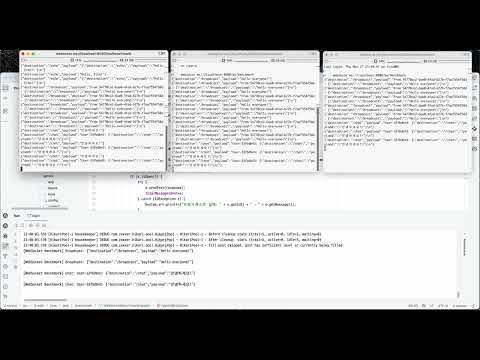
This video demonstrates Sprout’s fully non-blocking NIO WebSocket stack in action.
What’s shown in the demo:
- NIO-based WebSocket handshake & frame processing
- Concurrent client connections
- Echo, broadcast, chat-style messaging
- Ping/Pong frames
- Graceful close handling
- Non-blocking write queue with OP_WRITE toggling
The handler used in the video is a real application-level WebSocket handler built on Sprout’s APIs (see below).
@Component
@WebSocketHandler("/ws/benchmark")
public class WebSocketBenchmarkHandler {

    private static final Map<String, WebSocketSession> sessions = new ConcurrentHashMap<>();

    @OnOpen
    public void onOpen(WebSocketSession session) {
        sessions.put(session.getId(), session);
    }

    @OnClose
    public void onClose(WebSocketSession session, CloseCode code) {
        sessions.remove(session.getId());
    }

    @MessageMapping("/echo")
    public void echo(WebSocketSession session, @Payload String msg) throws IOException {
        session.sendText(msg);
    }

    @MessageMapping("/broadcast")
    public void broadcast(WebSocketSession session, @Payload String msg) throws IOException {
        for (WebSocketSession s : sessions.values()) {
            if (s.isOpen()) s.sendText(msg);
        }
    }

    @MessageMapping("/ping")
    public void ping(WebSocketSession session, @Payload String ignored) throws IOException {
        session.sendPing("ping".getBytes());
    }
}
Runs on Sprout’s NIO selector loop with non-blocking writes and frame-level control.
687 tests, 0 failures (100% pass, Gradle 8.10.1 · 2025‑10-27)
Test Coverage (Jacoco):
- Line Coverage: 85%
- Branch Coverage: 75%
Coverage highlights:
- Core container: scanning, bean graph/topological sort, constructor injection,
@Orderlist injection - AOP: advice builders/interceptors, advisor registry, pointcut parsing
- MVC layer: request parsing (line/header/query), handler mapping & invocation, argument resolvers, exception advice
- Security: authentication providers, password encoding, context propagation, filters & authorization aspect
- Server stack: HTTP Blocking/NIO/Hybrid strategies, executor services (virtual vs pool), protocol detectors/handlers
- WebSocket: handshake, frame encoder/parser, ping/pong, fragmentation, async write & graceful close, dispatchers/resolvers
- Utilities:
HttpUtils(Content-Length & chunked), response buffer creation, misc helpers
Tooling & style:
- JUnit 5 + Mockito (inline/lenient for JDK-final classes)
- Fake implementations where deterministic behavior beats heavy mocking (e.g., frame encoder/parser)
- Selector/
interestOpsstate fakes to validate NIO behavior without real sockets - Build report:
build/reports/tests/test/index.html
| Release | Planned / Done | Notes |
|---|---|---|
| v0.2 | ✅ AOP core delivered | @Before/@After/@Around, AspectJ pointcuts |
| v0.3 | ✅ Middleware & Global Interceptors | Filters + Interceptors chain |
| v0.4 | ✅ Data Access & Security Core | JdbcTemplate, @Transactional, AuthN/AuthZ |
| v0.5 | ✅ NIO & Hybrid Server, Async WebSocket | Selector loop, OP_WRITE mgmt, graceful close |
| v1.0 | 🎯 Stable API & Framework Maturity | comprehensive docs |
Post v1.0 Roadmap:
| Feature | Status | Description |
|---|---|---|
| Lightweight ORM | 🔄 Planned | Entity mapping, annotations-based ORM, simple query DSL |
| Production Tools | 🔄 Planned | Metrics, monitoring, better performance profiling |
| Advanced Features | 🔄 Planned | Enhanced security, caching layer, validation framework |
The roadmap is aspirational.
- Spring Framework — the architectural north star.
- Reflections, CGLIB, Objenesis, Jackson — runtime meta‑programming & serialization backbone.
PRs & issues welcome. Pick a roadmap item or pitch a feature. Let’s grow Sprout together.
MIT License. See LICENSE.