A single orbital-mechanics workload implemented four times — CUDA, C++/OpenMP, NumPy, and pure Python — behind one auto-selecting API, so you can measure where each backend wins and why. The orbital-mechanics UI is the excuse; the portability study is the point.


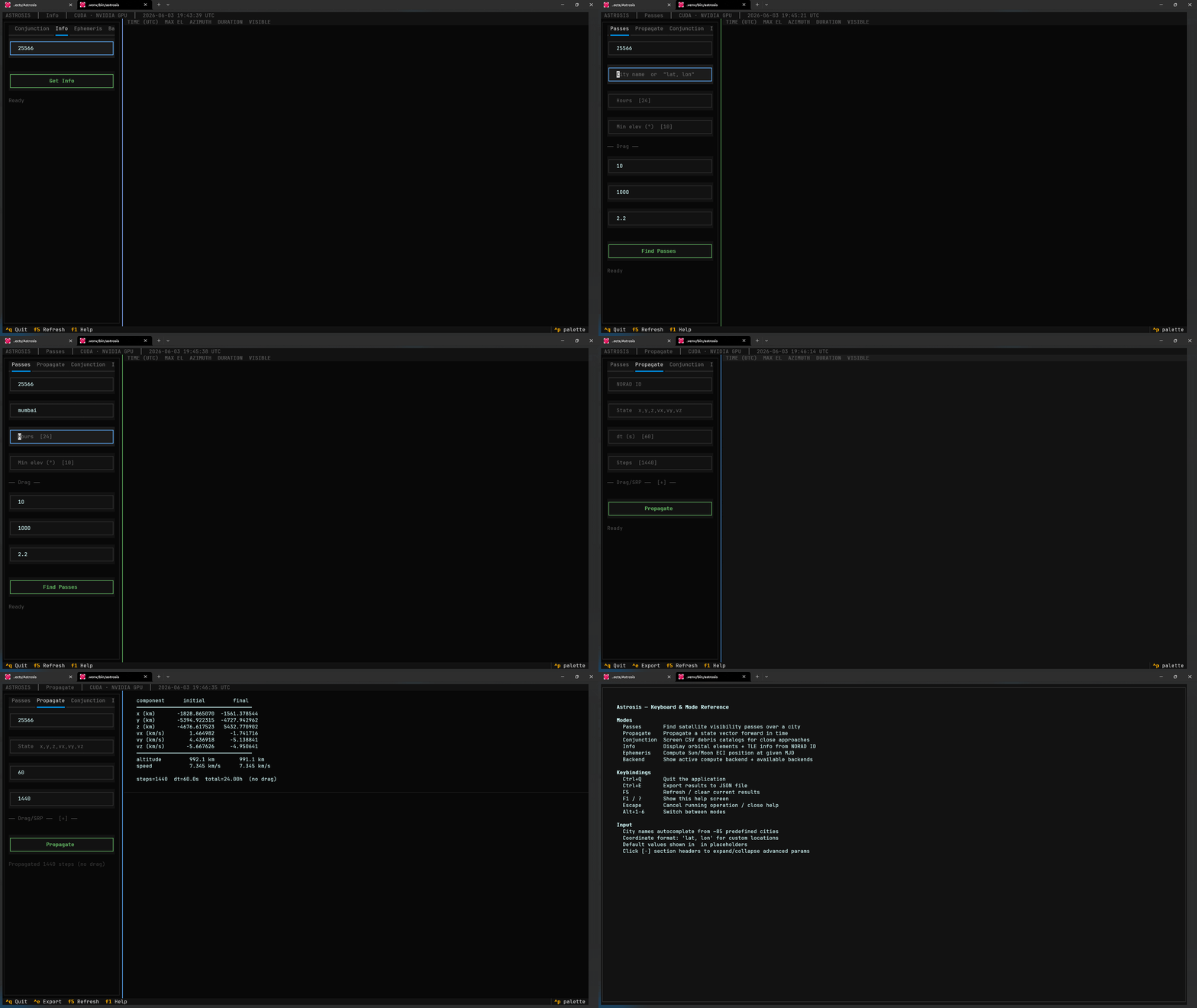
Table of Contents
Every backend computes the same RK4 + J2–J4 propagation, and the router in
astrosis/core/accelerator.py picks one at runtime. That setup turns three
questions you cannot answer from theory alone into measured data:
- When is the GPU the right tool? At what problem size does CUDA launch overhead + PCIe transfer stop paying for themselves?
- When is a multicore CPU the right tool? C++/OpenMP has no transfer cost and sub-millisecond latency — is it ever faster than a GPU?
- How portable is "portable"? One benchmark matrix, four implementations,
no vendor lock-in. Same numerics everywhere (FP64, IEEE 754, no
-ffast-math), so the comparison is honest.
The answers are in the benchmark numbers below — and one of them is counter-intuitive enough to matter for real systems design.
The CPU beats the GPU at batch propagation, and the GPU wins at conjunction screening. Same physics, same FP64 kernels, same machine.
| Operation | Python | C++/OpenMP | CUDA |
|---|---|---|---|
| Batch 1k sats × 864 steps | 7074 ms | 13 ms (566×) | 245 ms (29×) |
| Batch 5k sats × 864 steps | 36854 ms | 55 ms (676×) | 291 ms (127×) |
| Conjunction 200×200 1 h | 6262 ms | 498 ms (13×) | 45 ms (139×) |
| Conjunction 400×400 2 h | 26677 ms | 3856 ms (7×) | 125 ms (214×) |
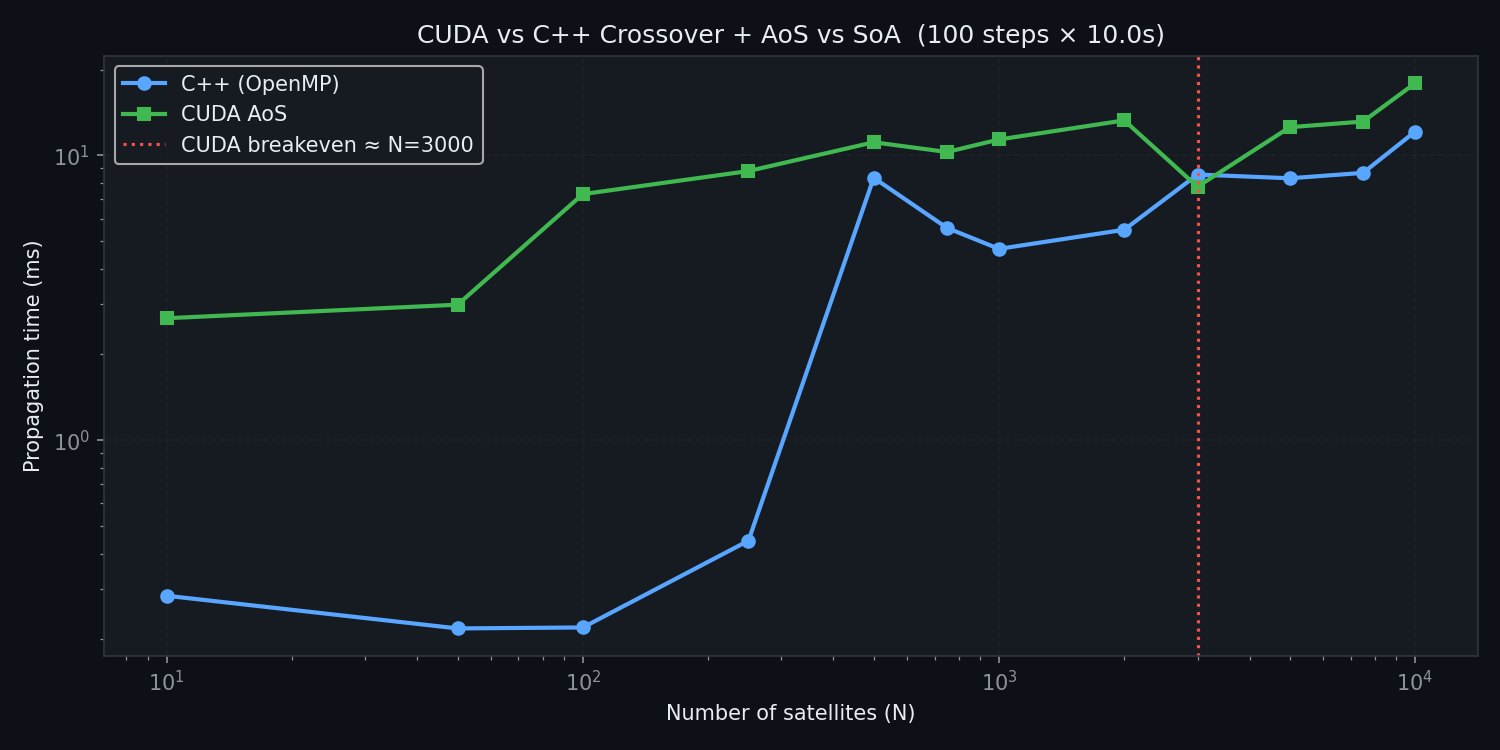
Why: propagation is launch-bound at these sizes — CUDA pays a fixed per-call cost plus a host↔device round trip, while OpenMP's cost is a few wakeups. When CUDA overlaps transfer and compute (streamed mode), the gap narrows (1k sats: 99 ms streamed vs 245 ms SoA) but does not close. Conjunction screening, by contrast, is a compute-bound pairwise scan with no per-satellite launch — that is where 16 SMs beat 6 cores, by up to 214×.
The shape of this trade-off — "offload only if the kernel is big enough to amortise the transfer" — is the transferable lesson. Detailed scaling, SoA-vs-AoS memory layout (1.4× throughput, ~6.8× bandwidth utilisation), roofline (kernel is compute-bound at 2.5 FLOP/byte vs a 1.04 ridge point), and kernel occupancy (100% propagation, 92% conjunction) live in docs/performance.md.
pip install astrosis

# TUI (no args)
astrosis

# CLI
astrosis passes --city Mumbai --id 25544
astrosis info --id 25544
No GPU required — CUDA is optional. Falls back to C++/OpenMP → NumPy → Python automatically on any machine. Python ≥ 3.10.
import astrosis

# Propagate a single satellite forward
state = astrosis.propagate(
    [6678, 0, 0, 0, 7.7, 0],  # ECI: x, y, z, vx, vy, vz (km, km/s)
    dt_seconds=86400
)

# Batch propagate — auto-picks fastest backend
states = astrosis.propagate_batch(
    initial_states, dt_seconds=60, steps=1440
)

# Conjunction screening
warnings = astrosis.detect_conjunctions(
    satellites, debris, lookahead=86400, step_s=60
)

# Check which backend is active
print(astrosis.backend_info())
Full reference: docs/api.md.
| Category | Capabilities |
|---|---|
| Propagation | RK4 with J2/J3/J4, atmospheric drag (US Standard 1976), SRP, lunisolar third-body |
| Auto-backend | CUDA GPU → C++ OpenMP → NumPy batch → Python fallback |
| Conjunction | KDTree broad-phase, pairwise distance scan, Brent TCA refinement, Chan collision probability |
| Pass prediction | SGP4 → RK4 handoff, elevation/visibility filtering, ~85 cities built-in |
| Ephemeris | Sun/Moon ECI positions via VSOP87/ELP-2000, eclipse state (umbra/penumbra) |
| TUI | 6 modes, help overlay, JSON export, persistence, autocomplete cities |
| Coordinate frames | ECI ⇄ ECEF, TEME → ECI, geodetic, topocentric (az/el/range), GMST + equation of equinoxes |
Position accuracy: integrator error < 0.1 km at 24 h. Real-world accuracy is dominated by TLE uncertainty (0.1–1 km), not the propagator. All backends are validated against SGP4 and energy-conservation checks in docs/validation.md — identical physics, not just identical output.
Benchmarked on RTX 2050 + Ryzen 5. Full suite, scaling analysis, roofline, and occupancy: docs/performance.md.
| Operation | Python | C++ | CUDA |
|---|---|---|---|
| Single sat (50k steps) | 391 ms | 21 ms (19×) | N/A |
| Batch 1k sats × 864 steps | 7074 ms | 13 ms (566×) | 245 ms (29×) |
| Batch 5k sats × 864 steps | 36854 ms | 55 ms (676×) | 291 ms (127×) |
| Conjunction 200×200 1h | 6262 ms | 498 ms (13×) | 45 ms (139×) |
| Conjunction 400×400 2h | 26677 ms | 3856 ms (7×) | 125 ms (214×) |
C++/OpenMP is faster than CUDA for batch propagation at all tested sizes (no PCIe overhead, no per-call launch). CUDA dominates conjunction screening where pairwise calculations are compute-bound.
See docs/performance.md for full benchmarks, scaling analysis, roofline, and kernel occupancy. See docs/validation.md for physics validation results (energy conservation, SGP4 comparison, J2 regression, etc.).
graph TB
    subgraph UI["User Interface"]
        CLI["astrosis/cli.py"]
        TUI["astrosis/tui.py<br/>Textual 8.x"]
        API["astrosis.*<br/>Python API"]
    end

    subgraph CORE["Physics Core"]
        PROP["Propagator<br/>RK4 · J2–J4 · Drag · SRP<br/>Lunisolar"]
        CONJ["Conjunction Detector<br/>KDTree · Brent TCA<br/>Chan Pc"]
        PASS["Pass Predictor<br/>SGP4→RK4 · AER<br/>Eclipse check"]
        EPHEM["Ephemeris<br/>Sun VSOP87 · Moon ELP-2000"]
        FRAMES["Frame Transforms<br/>ECI ↔ ECEF ↔ Geodetic<br/>TEME→ECI · Topocentric"]
    end

    subgraph BACKEND["Backend Layer<br/>(auto-selected)"]
        CUDA["CUDA GPU<br/>SoA kernels"]
        CPP["C++ / OpenMP<br/>pybind11"]
        NUMPY["NumPy batch<br/>Vectorised"]
        PYTHON["Python fallback"]
    end

    subgraph DATA["Data Sources"]
        TLE["TLE Ingestor<br/>CelesTrak / Space-Track"]
        CITIES["City Database<br/>~85 cities"]
    end

    CLI --> CORE
    TUI --> API
    API --> CORE
    PROP --> BACKEND
    CONJ --> BACKEND
    PASS --> FRAMES
    PASS --> PROP
    PASS --> EPHEM
    CONJ --> PROP
    TLE --> PROP
    CITIES --> PASS
The router in astrosis/core/accelerator.py selects the best backend. See
docs/architecture.md for data flow details and
docs/design.md for design decisions (fixed-step RK4 vs
adaptive, J2–J4 vs EGM2008, AoS vs SoA, FP64 vs FP32).
Astrosis automatically picks the fastest backend for each operation: CUDA GPU → C++/OpenMP → NumPy batch → pure Python.
$ astrosis backend
╭─────────────────────────────── Backend Status ───────────────────────────────╮
│ Active backend: CUDA                                                         │
│       ✓ CUDA  ✓ C++/OpenMP  ✓ NumPy batch  ✓ Python fallback                │
│ GPU: NVIDIA GPU                                                              │
╰──────────────────────────────────────────────────────────────────────────────╯
ASTROSIS_MOCK_GPU=1 forces CPU only.
Six modes (switch with Alt+1–Alt+6):
| Mode | What it does |
|---|---|
| passes | Predict satellite passes for a city or lat/lon |
| propagate | Propagate a NORAD ID or state vector forward |
| conjunction | Load CSVs and screen pairs for close approaches |
| info | Orbital elements, current ECI state, ground track |
| ephemeris | Sun/Moon ECI positions and distances |
| backend | Active compute backend and GPU info |
Keybindings:
| Key | Action |
|---|---|
Alt+1–Alt+6 |
Switch mode |
Enter |
Run current mode |
Escape |
Cancel running operation |
Ctrl+E |
Export results to JSON |
F5 |
Refresh / clear results |
F1 / ? |
Show help overlay |
↑↓ |
Select result row (detail strip) |
Ctrl+Q |
Quit |
Drag/SRP parameters and conjunction advanced options are hidden behind
clickable [+] section headers. Input values persist across sessions
via ~/.cache/astrosis/tui_state.json.
| Command | What it does |
|---|---|
astrosis |
Launch interactive TUI |
astrosis passes --city <name> --id <norad> |
Predict satellite passes |
astrosis info --id <norad> |
Orbital elements and current state |
astrosis propagate <state or id> --dt 60 --steps 1440 |
Propagate forward |
astrosis conjunction --primary a.csv --secondary b.csv |
Conjunction screening |
astrosis batch <file.csv> --steps 100 |
Batch propagate from CSV |
astrosis backend |
Show active compute backend |
astrosis fetch --id <norad> |
Fetch and cache TLE data |
astrosis ephemeris --mjd 60000 |
Sun/moon positions |
Contributions welcome. See docs/contributing.md for dev setup, tests, code style, and PR workflow.
MIT