TaxonomicHeterogeneity
Link to alternative version of ontology which includes heterogeneous entities
In the discussion of October/November 2010 regarding the proposal to add the class Individual to the Darwin Core standard, there was substantial discussion of the scope of an Individual and whether an Individual should be defined in such a way that it was limited to resources that were taxonomically homogeneous. Certain constituencies of the TDWG community (notably the marine and aquatic museum community) routinely collect samples which contain a wide variety of types of organisms. These samples are considered specimens, are assigned identifiers, and may be identified to the lowest taxonomic level shared by the taxonomically heterogeneous organisms represented in the sample. It was felt by some that the proposed class should describe samples of this kind. However, others felt that this would introduce unwanted complexity and make it difficult to infer "duplicates". (See the wiki page ClassIndividual for references on this discussion.)
It is not clear to us how to define the properties necessary to fully describe a class that would include taxonomically heterogeneous entities. However, we also do not want to create the structure of DSW in such a way that it would be impossible to define these properties at some point in the future. We have chosen an approach which creates a class that serves the role originally envisioned for the proposed dwc:Individual class (dsw:IndividualOrganism), while also allowing for future refinement of a class to describe taxonomically heterogeneous entities. The basic dsw.owl ontology considers only taxonomically homogeneous entities. However, we have created an alternative ontology (dsw_alt.owl) which adds two classes and allows for the inclusion of taxonomically heterogeneous entities.
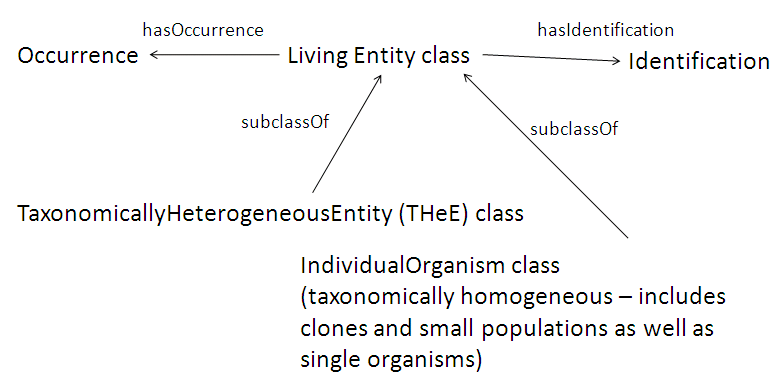
An instance of the superclass dsw:LivingEntity is a resource that can be assigned to a Taxon at any level. If the LivingEntity is taxonomically heterogeneous, the Taxon assigned by a determination would be the lowest level that was common to all individual organisms present in the LivingEntity. The Occurrence record would document the time and place where the LivingEntity was observed.
The class dsw:LivingEntity has two subclasses, dsw:TaxonomicallyHeterogeneousEntity and dsw:IndividualOrganism. As subclasses of dsw:LivingEntity, they share all of the properties of that class, namely they can be related to Occurrence via dsw:occurrenceOf/dsw:hasOccurrence and to Identification via dsw:idBasedOn/dsw:isBasisForId . These two subclasses differ in that instances of TaxonomicallyHeterogeneousEntity (THeE) are known to be taxonomically heterogeneous (i.e. the entity contains two or more kinds of organisms) while instances of IndividualOrganism are believed to be taxonomically homogeneous (e.g. single biological individuals, clones, colonial organisms, small populations of the same kind of organism). If it is discovered that a resource which was thought to be taxonomically homogeneous is actually taxonomically heterogeneous, it can simply be re-typed from IndividualOrganism to TheE. We do not formally define taxonomic homogeneity or heterogeneity in the alternative OWL ontology, although that might be done at some future time.
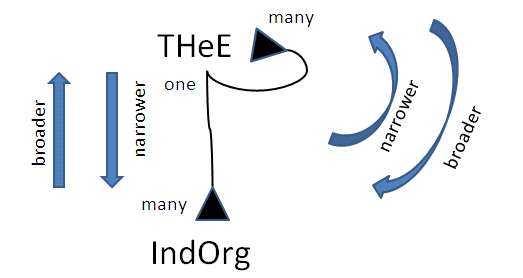
THeE instances can be subdivided into two or more other child THeE instances that each have a narrower taxonomic scope than the parent. A THeE can also be subdivided into two or more IndividualOrganism instances that have a narrower taxonomic scope than their parent THeE. But an IndividualOrganism cannot be further subdivided. Note: we do not specify what kind of things THeE and IndividualOrganism can or cannot be. They just must connect one or more Identifications to one or more Occurrences.
LivingEntity instances can be documented by any kind of Token without restriction. The token can be considered to be a part of the LivingEntity, a representation of the LivingEntity, or the entire LivingEntity itself. The only restriction is that the same level of taxonomic uncertainty apply to the Token as to the LivingEntity. For example, if a clump of grass which is believed to be taxonomically homogeneous (i.e. an IndividualOrganism) exists in a botanical garden, a stem of the grass removed and pressed (a PreservedSpecimen), an image of the clump of grass or any part of it (e.g. a leaf), a tissue sample from the clump, a DNA sequence from the clump, and the entire clump itself (as a LivingSpecimen) can be considered to be derived from the IndividualOrganism. It does not matter if the clump consists of several individuals or a single clonal individual as long as all parts of the clump are taxonomically homogeneous. The token can be subdivided into pieces or extracts which are assigned their own GUIDs but they would still be represented by the same IndividualOrganism.
A Token which documents a THeE can be subdivided into pieces or extracts. If the pieces have the same level of taxonomic uniformity, they can be represented by the same THeE. However, if the pieces (a new Token) are sorted in such a way that they are represented by a common taxon at a lower level than the original THeE, then the new Token should be assigned to a child THeE whose taxon is a child of the parent THeE. If the child Token is believed to be taxonomically homogeneous, then it should be assigned to a child IndividualOrganism whose taxon is a child of the parent Taxon. At this point, no further subdivision of the LivingEntity is possible.
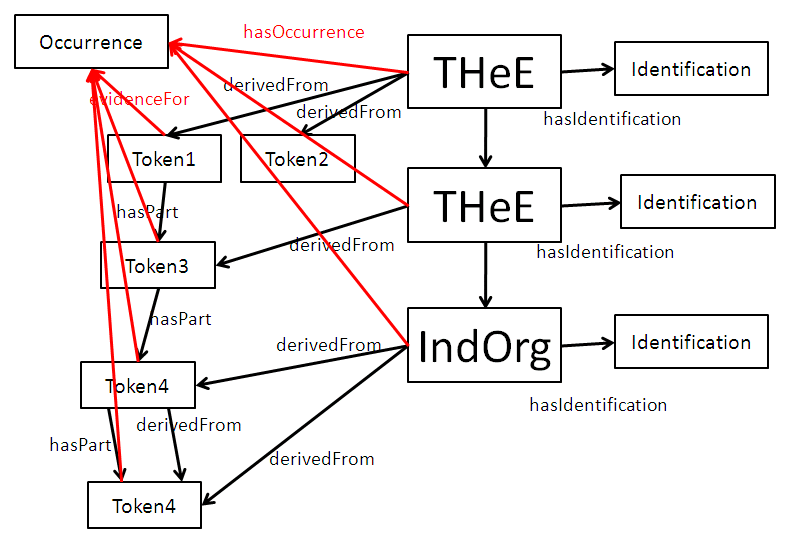
Although DSW and dsw_alt.owl define the general terms dsw:derivedFrom and dsw:hasDerivative, neither ontology defines terms to describe the specific relationship among Tokens and their pieces, extracts, or representations. Terms from other vocabularies, such as dcterms:hasPart and foaf:depiction can be used to describe the relationships among Tokens and their derivatives.
dsw_alt.owl does not define the properties that would be necessary to describe the behavior of a THeE and its relationship to Identifications, the Taxon class, and other THeE instances. In fact, introduction of THeE creates a level of complexity significantly greater than that which would exist if DSW were restricted to IndividualOrganisms exclusively (as can be seen from the diagram above). However, dsw_alt.owl includes the LivingEntity and TaxonomicallyHeterogeneousEntity classes in its model to make their further development possible.
There is no requirement in dsw_alt.owl that any resource be described as a THeE - any dataset may be limited exclusively to resources that are described as instances of IndividualOrganism. If there is significant demand for inclusion of THeE resources, then the dsw_alt.owl ontology could be used in lieu to the basic dsw.owl ontology. Since in dsw_alt.owl IndividualOrganism inherits the same properties from LivingEntity that are declared explicitly for IndividualOrgansim in dsw.owl, implementations based on dsw.owl should not be "broken" if the alternative ontology is accepted.